Venture Studio & Incubation Cycles
“What season is my portfolio actually in?”
Builders who run portfolios need the long view: which years favour planting, which favour harvesting. The Definitive's twelve-month and whole-life reads give you the cycle map underneath the pipeline.
The hardest call in a studio is not what to build. It is what to keep.
You are running seven things at once and every one of them wants the same scarce input, which is you. Not the capital, which is committed, and not the team, which is hired. Your attention, your conviction, and the hours that go to whichever venture is currently loudest. The loudest one is rarely the one that most deserves them.
The studio maths only works if one or two ventures carry the entire book. Which makes the expensive mistake not the bet that failed, but the bet you starved during the eighteen months it looked identical to the one that failed. You shut down things that were early rather than wrong, and the ledger never tells you which were which.
The clock is the position you never diversified.
The doctrine is shots on goal. Run the bets in parallel, stage the capital, kill fast, double down on what moves. It is borrowed from portfolio investing, where diversification works because the positions are held by capital, and capital has no seasons. A studio is not that. Every venture in the book is underwritten by one operator's recruiting, one operator's fundraising posture, and one operator's willingness to keep a thing alive through month fourteen when the evidence is still thin. That is a shared input inside every position you hold.
So the true correlation across your portfolio is not sector and it is not stage. It is your own year. When your year favours consolidation, every venture in the book meets a consolidating operator, regardless of what its own stage was asking for. A chart read against the next twelve months names what the year is rewarding and what it is taxing: the appetite to originate, the patience to hold through the flat middle, or the standing to hand a thing over. Studios adopt cadence policies, four launches a year, precisely so nobody has to make that judgement. The cadence then drives straight through the seasons that were never going to reward a launch.
Here is the uncomfortable part. Harvest years look like idle years from inside the building. Nothing new is being announced, the pipeline slide is flat, and the team begins to wonder whether the studio has run out of ideas. So operators plant, because planting is visible, and the venture that was ready to be spun out, sold, or handed to a real chief executive gets one more year of half-attention instead.
Nothing in the book is uncorrelated when one person has to keep believing in all of it.
A studio operator runs five distinct capacities, and no chart carries them equally. The report's five mirrors, on leadership, decision-making, conflict, romance and money, are written as structural portraits rather than compliments, and the strategic architecture puts its longest section against the priority you name at intake. Your report draws this from your real birth data, cast and verified before a word is written.
The year does not treat originating, backing, consolidating and selling as the same act. The report maps twelve months as major transitions, a quarterly strip, and four quarterly deep dives read against the goals you state at intake. Planting quarters and picking quarters arrive named, separated, and carrying dates.
Drawn from your real chart in OrbitWise Definitive, delivered within 5 days.
Get the DefinitiveWhat portfolio builders never think to ask.
Studio operators arrive asking which venture to double down on. The six below are about the operator rather than the book, which is the variable no pipeline review has ever put on the agenda.
Which way you lean in the kill call
No dashboard separates a gestating venture from a dying one, because both show the same flat months. The only correction available is knowing your own standing bias, and every operator carries one: cutting a quarter early to protect focus, or holding a year late to protect a relationship. The two errors are not symmetrical. Cutting early costs you one company. Holding late costs you the book, because the studio maths needs the eventual winner funded, not the patient loser kept comfortable.
The seat you should hold in your own portfolio
There are four or five seats available inside your own book, and most operators are still sitting in the one they most enjoyed a decade ago. The attention you are good at giving now is not the attention you built the studio to give, and the two drift apart across a career without anyone announcing it. The book pays for that nostalgia in every company that needed a different sort of attention from the one it got, and the drift is legible in advance of the next seat you take.
The cadence your attention actually supports
Studios set launch cadence from capital and calendar, never from the operator. Past a certain count, attention degrades rather than divides. Hiring more staff does not move that ceiling and neither does a bigger fund, because the constraint is you. The number of ventures you can genuinely underwrite is lower than the number on your pipeline slide, and it is knowable before you commit to the fourth.
The order you cut in when the balance sheet tightens
The order you cut in is decided before the numbers are opened. Operators cut the venture whose founder will take the news best and carry the one whose founder would be wounded by it. That is a relationship decision filed under portfolio discipline, and it is worth knowing which of the two your last round of cuts actually was.
When to tell an operator the truth
Replacing a founder, cutting a budget, winding a company down. The message is identical in March and in September, and it lands as a reset in one window and as a betrayal in the other. Most operators time these conversations around their own readiness to have them, which is the one input that has nothing to do with how the news will be received. Named and dated ahead of the year, the conversation you owe someone becomes something you schedule rather than something you trigger.
Whether the studio belongs to this chapter
Operators treat the studio as the destination and read any restlessness about it as disloyalty. For some it genuinely is the work of the chapter they are standing in. For others it is the vehicle carrying them into the next one, and the tell is not boredom, it is that the ventures start being chosen to justify the structure rather than the other way round. Neither reading is a verdict on the companies. Both change what the next twelve months are for, and a life read as three bounded chapters rather than one continuous run makes it plain which of the two you are in.
What the read actually names.
Where the studio sits in a hundred years
A hundred-year view of your major periods, then the three chapters of your life named and bounded. You see whether you are building inside an expansion chapter or a consolidating one, which is the difference between a pipeline plan and a handover plan.
The period you are building inside
A deep dive on the major period you occupy now: what it rewards, what it taxes, and how long it runs. This is the layer that explains why one operating style carried a decade of momentum and then stopped converting.
Twelve months, quarter by quarter
The year's major transitions, a quarterly strip you can hold against the pipeline, and four quarterly deep dives. Planting quarters and picking quarters are named separately, with dates attached.
Five mirrors of how you operate
Leadership, decision-making, conflict, romance and money, each written as a structural portrait rather than a compliment. For a portfolio builder, the decision-making and conflict mirrors are usually the two that reorganise the next year.
Alignment, weighted to your stated priority
A strategic architecture whose longest section goes to the priority you named at intake, alongside a warnings page, a health vigilance page, and a city scorecard for where the work should be based. Written against your chart and your own answers, never a generic template.
The near ground
The four layers of the present moment, a thirty-day outlook, and the week ahead in detail. This is the part you read on a Monday, sitting underneath the parts you study once.
The Definitive is cast once, on a long-form intake, and runs forty-one to forty-seven pages delivered within five days. There is no annual re-cast: owners are invited into the quarterly rhythm of the OrbitWise Report instead.
Most of the book is still undecided when the twelve months are up.
The dataset comes first, and the document is written out of it: your chart, the long-form intake where you named the ventures and what you owe each founder, the three chapters, the planting quarters set apart from the picking ones. Forty-odd pages settle which season the book is in and where the studio belongs in it. It does not close when the binding does.
Venture four has been flat for five quarters and nothing separates gestation from decline. Does the year ahead favour holding it through, or is holding the bias the report already named in you? It answers from your own periods, and where the dataset holds nothing it says so rather than inventing a placement. The fund's capacity to carry another year is your accountant, and your LPs on the fund's own constraints.
What your reading learns about you is kept. The next thing you read starts from everything the last one knew.
Aster runs on a monthly plan. The deeper readings include a run of free days with him, and the credits the plan gives you each month go toward your next Report. Subscriptions are not open right now. See what Aster costs.
Our position.
Free will and personal choices matter most. No chart has ever wound a company down with dignity. Operators do that, in a room, with a person who trusted them, and the read does not carry a single one of those hours for you.
What the read offers is terrain, not destiny: which capacity each of the coming years favours, and which one it quietly taxes. Builders who know their terrain still choose every bet themselves. The difference is that an unannounced year stops registering as a gap in the record.
And it is one instrument among several. Take your corporate counsel's read on the structure, your accountant's read on the studio's numbers, your investors' read on the pipeline, and the honest read your operators give you about their own companies. Then read the year, because every one of those covers a single company at a time, and the input all seven of them share is the one nobody has audited.
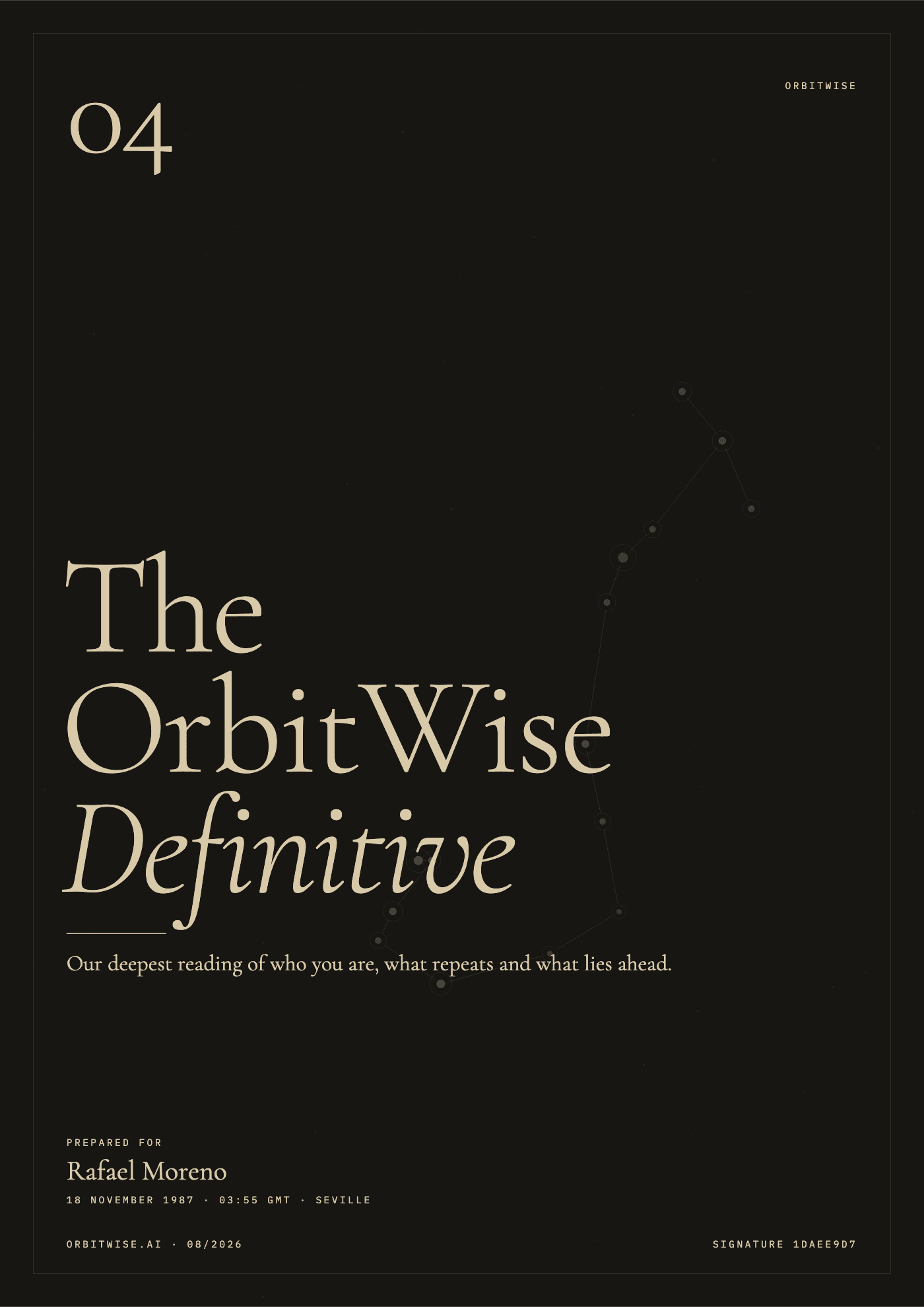
The artefact
OrbitWise Definitive
- Your major life periods
- The next twelve months in depth
Bring the question: “What season is my portfolio actually in?”
No account needed to buy · delivered within 5 days.