Company Incorporation Date Selection
“Which date do I sign the papers?”
Bring the incorporation date to the OrbitWise Report as a direct question. You get the windows across the next ninety days that the chart favours for beginnings, the ones to let pass, and the three weeks worth protecting around the signature.
Is there a good date to register my company, and can astrology choose it?
Choosing a date to begin something is a recognised astrological practice with its own name. Western astrology calls it electional astrology. The Vedic tradition calls it muhurta. It is a different technique from reading your own birth chart, and that difference decides what anyone can honestly tell you.
An election works by casting a chart for the moment you propose to act, then judging that chart. The undertaking is treated as beginning at that moment, so the moment gets a chart of its own. Reading your birth chart does something else: it describes you, and the periods you are moving through. A birth chart cannot by itself produce a classical election, because an election needs a chart cast for the moment being elected.
OrbitWise reads your chart, not the company's. So the honest answer to the incorporation question here is not an auspicious day drawn from an almanac. It is a reading of which stretches of your next ninety days your own chart associates with beginning something, and which stretches it associates with finishing what is already open. For most founders that is the more useful question, because a registry queue controls half the dates anyway.
What the reading is actually looking at.
Two timing methods sit behind a personal reading and they work differently. Planetary periods are a sequence calculated from the position of the Moon at your birth: a long period of roughly six to twenty years, subdivided into shorter ones that run from months to a few years. Their order is fixed at birth. Transits are the separate question of where the planets are now compared with where they stood when you were born.
A reading of a founding decision uses both, and reads them against the houses traditionally associated with the subject. In the Vedic scheme that includes the tenth house for career and public standing, the eleventh for gains and networks, and the second for wealth. Those are conventional significations rather than measurements, and what a reading builds from them is an interpretation.
The ranking you receive is relative. The days in your window are compared against each other rather than scored against an absolute standard, so what you see is the shape of your own quarter, not a claim that certain dates are universally fortunate.
A worked example.
Invented for illustration. Not a customer, and not a prediction.
Take an invented founder who wants to register a consultancy. Her formation agent can lodge the papers in any week of the next three months, and her co-founder is travelling for two of them. The share split is agreed in principle and unsigned.
Suppose her reading places her in a longer period an astrologer would associate with consolidation, inside a shorter one associated with visibility, while the transit picture emphasises partnership questions through the middle month. A reader could take that combination as a quarter better suited to settling terms than to opening something new, with the middle weeks most likely to bring the partnership conversation to a head.
The practical answer that follows is not a lucky date. It is to use the first weeks to close the split while the co-founder is still reachable, expect that conversation to want the middle of the quarter, and place the filing after it rather than before. Settle the split early and the later window becomes the one that can carry a beginning.
Every sentence of that is interpretation. A different astrologer could read the same chart and emphasise something else. What makes it useful is that it converts into a decision you can hold, act on and check against what actually happens.
What a reading needs, and where it stops.
What a reading needs from you
- Your date, time and place of birth. For a timing question the birth time carries the most weight.
- If your birth time is uncertain, say so rather than supplying a guess.
- The decision as you actually face it: the options genuinely open to you, and any deadline you cannot move.
What it can reasonably give you
- A reading of which weeks in your window your own chart associates with beginning, and which with completing.
- Named windows with specific dates rather than a vague season.
- Your question answered in writing, in language that does not assume you know astrology.
What it cannot do
- It is not a classical election. No chart is being cast or judged for the company's own founding moment.
- It cannot establish whether the company will succeed, or forecast its revenue.
- It does not replace your lawyer on structure, your accountant on the year end, or the registry on what it will accept.
- Product launch timing the same timing question applied to shipping rather than filing.
- Co-founder compatibility if the harder question is the person you are signing with.
- The OrbitWise Report answers three questions of your own alongside the next 90 days.
- The Missing Minute the reading for an uncertain birth time.
The one decision in the whole formation you can never revise.
You spent months on the name, weeks on the cap table, days on the articles, and roughly four minutes on the day you signed. That day was chosen by a portal queue, an agent's reply time, or whichever Friday the notarised documents happened to be in hand. It is now fixed on every filing, every diligence pack and every renewal notice, and it is the only part of the formation nobody will let you redo.
What a badly placed date charges is not dramatic, it is annual. The renewal falls in the week the business is thinnest, so every year the same four days go to compliance instead of revenue. The audit lands beside the quarter that already owns your attention. The year end sits where it forces a raise to open in the wrong month. None of it is fatal and all of it is billed again next year, for as long as the company exists, against a decision that took four minutes.
This is not an election for the company. It is a reading of the person signing.
The standard counsel on an incorporation date is logistical. File when the documents clear, defer a few weeks to push the first renewal fee into the next cycle, and let the formation agent lodge the papers on whichever morning the portal is behaving. Every line of it is competent administration, and every line of it treats the date as an output of the process rather than a decision inside it. That is how a founder ends up with a permanent line on the certificate chosen by a queue.
The alternative is not a lucky day, and it is not an election either. Electional astrology casts a chart for the founding moment itself and judges that. OrbitWise does not do that. It reads your own chart and the periods you are moving through, because what is actually deciding on signing day is you. Every founding act runs through the founder, the jurisdiction chosen, the split agreed, the first call made in week one, the tolerance for a process that will grind for six weeks. So the question a read can answer is not what the company will become. It is which of the next ninety days finds you able to begin, and which of them finds you able only to finish what is already open.
The day you most want to file is usually the worst one available. Founders sign in the week the decision finally stops feeling open, which is the week the pressure peaked, and pressure is not readiness. Inside any quarter there are days that favour a beginning and days that favour the closing of something already started, and they are rarely the days your inbox is pointing at.
The certificate outlives every decision you agonised over, and it records the one you never made.
A founding date does not build a business, it stamps one. Which of these a start would draw on most is what the read weighs when it answers your date question, and it names what the strongest of them asks for in return. Your report draws this from your real birth data, cast and verified before a word is written.
The next ninety days are not flat. The report ranks the thirteen weeks day by day into peak, strong and steady bands, then names two or three protected windows with specific dates: the ones that favour a beginning, and the ones better spent closing what is already open. Signing is a one-day act, so the dates arrive to the day.
Drawn from your real chart in The OrbitWise Report, delivered within 48 hours.
Ask my three questionsWhat founders never think to ask before they file.
The question most founders bring is which day is lucky. The OrbitWise Report answers three questions of your own, alongside five short context questions it always asks. These are the ones worth writing.
Which act is the actual beginning
Signing, lodging, the registry's stamp, the licence issuing, the first transfer into the account. These are different days and only some of them are yours to place. Asked as one of your own questions, the answer names which act to place deliberately and which to let land where it lands, so you stop optimising a date a registry clerk controls.
What the quarter is for if it is not for founding
Some of the ninety days in front of you favour an opening and some favour a collection. A window that will not hold a beginning will often hold a price rise, a renegotiated contract, or the invoice you have been too polite to chase, and a founder who spends the quarter that way files a month later against work that is already closed. That changes what the entity is standing on at day one. The named alternative use of the month is the answer worth having, not the instruction to wait.
The date you will be handed back every year
A founding date is not one day. It is a slot in the year returned to you at every renewal, every audit, every anniversary the deck quotes. Your accountant can price what that slot costs in tax, and should. Nobody prices what it costs in attention. The ninety days before you file are the only stretch in which that slot is still movable, and after that it stops being a choice you are making and becomes a fact about the company.
How much slippage the window can absorb
Notaries run late, names get rejected, registries queue. A single favoured day is useless if you cannot physically reach it. The report names windows with edges rather than lucky dates, so a two day slip does not undo the choice you made.
What you do when the share split goes quiet
The real stall in company formation is not the registry, it is a co-founder who stops replying about percentages while the paperwork keeps moving. Under that specific pressure you have a default: file alone, file on a placeholder split you will have to reopen, or stop everything and wait it out. You will run that default whether or not you have ever looked at it. Named in advance, it stops being a reaction and becomes a position you can hold for a fortnight without flinching.
Whether the entity should precede the first contract
Sign the client first and the company arrives with revenue attached: the bank is easier, the jurisdiction is argued by where the money comes from, and the first cap table conversation happens against a business rather than an idea. Incorporate first and you buy the ability to sign at all. The same month produces two different companies depending on the order. Write it as one of your own questions and the answer comes back dated rather than theoretical.
What the OrbitWise Report actually puts on the page.
Your incorporation question, answered
The date question gets a full page to itself: the answer, dated and prescriptive, written to be read by someone who knows nothing about astrology and has a formation agent waiting on an email.
Two more questions, yours to write
Alongside five short context questions, the OrbitWise Report answers three questions you write yourself, each on its own page. The jurisdiction, the partner, the first hire, the money. No fixed template decides those for you.
The ninety-day calendar
Your next ninety days ranked into peak, strong and steady bands, month by month. The ranking is relative, each day ranked against the others in your window rather than against an absolute scale, so the shape of the quarter is visible before you commit a signature to it.
Two or three protected windows
Dated to the day, with what each window favours and what it is worth spending on. A beginning and a filing deadline do not want the same week.
Every date named specifically
The report either names a date or does not claim a window. Around the middle of next month is not something OrbitWise will send you.
The closing note, and what comes next
A short close, signed OrbitWise, naming what the deeper tiers open and what the twelve months after this quarter are shaped like.
The OrbitWise Report is cast for one ninety-day window and delivered within 48 hours. It is built to be re-cast each quarter on the data you have already given, so the company second quarter gets its own document rather than an extension of this one.
Incorporation is one dated decision that creates a dozen more.
Answering one date question means a record gets built first: your birth data resolved into a chart, the questions you put to it, ninety days ranked against each other, and every window written down beside what that window was for. Filing spends the date. It spends none of the rest. You spend the answer once. You keep everything that produced it.
The astrologer holds all of it, and whatever you have raised since. Six weeks after the company is real, the bank offers an account appointment and a first client wants a contract signed the same fortnight. Ask which to take first and it weighs the two against the periods your chart is running, not the order the emails arrived in. On what your year end does to the tax it sends you to a tax adviser.
What your reading learns about you is kept. The next thing you read starts from everything the last one knew.
Aster runs on a monthly plan. The deeper readings include a run of free days with him, and the credits the plan gives you each month go toward your next Report. Subscriptions are not open right now. See what Aster costs.
Our position.
Free will and personal choices matter most. No chart has ever drafted articles, negotiated a shareholders agreement, or found the first customer. Founders do that, and a well chosen date will not rescue a company that has nobody to sell to.
What the read offers is terrain, not destiny: which of the next ninety days will carry a beginning, and which will only carry a finish. Founders who know the terrain still choose the date themselves. What changes is that a date gets chosen at all.
And it is one instrument among several. Take your lawyer's read on the structure, your accountant's on the year end and the tax consequence, your formation agent's on what the registry will actually accept, and your banker's on when the account can realistically open. Then read the ninety days, because every one of those advisers is telling you what to file, and the question of which day to file it on is the one none of them will answer for you.
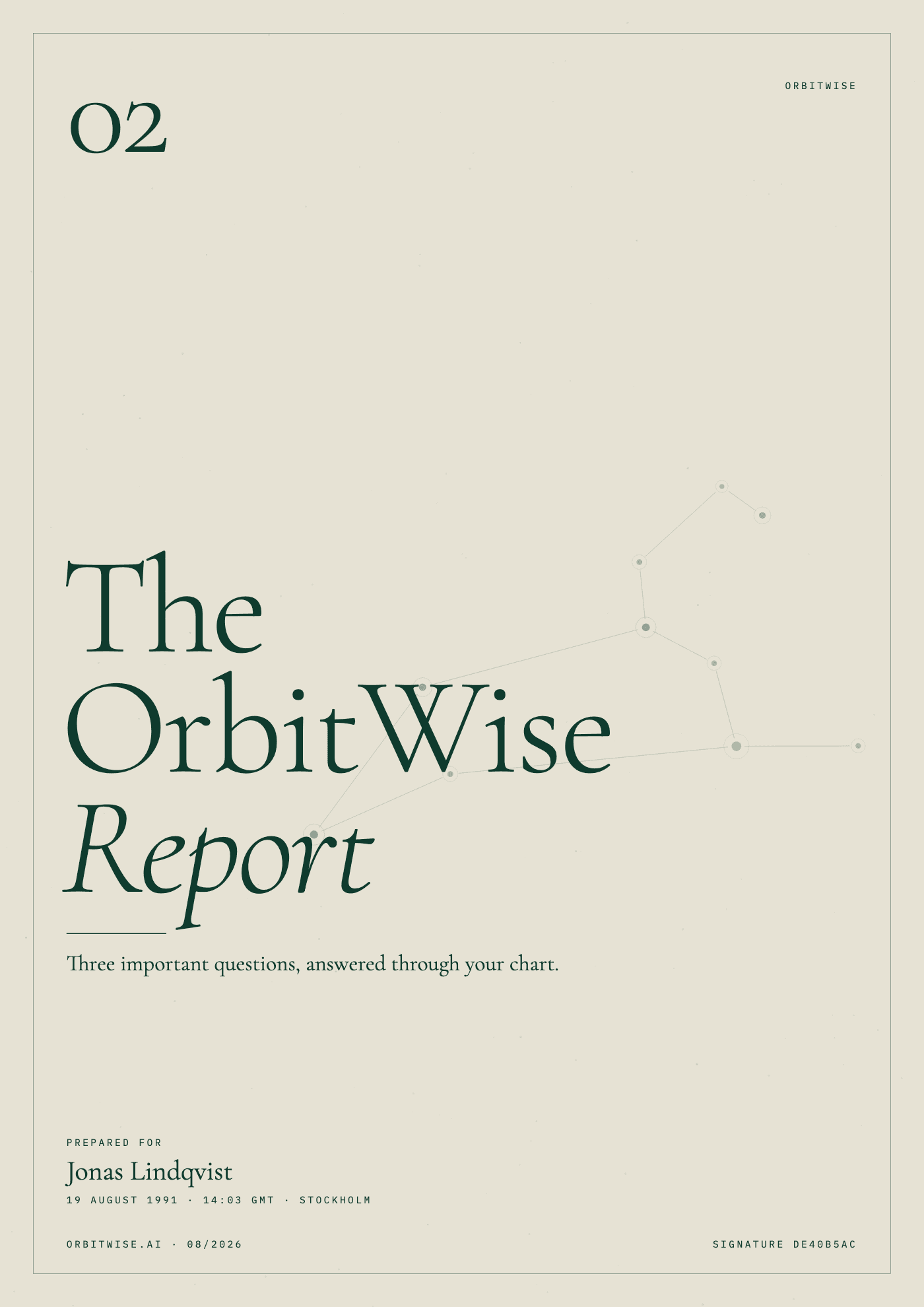
The artefact
The OrbitWise Report
- Three questions chosen by you
- Personal answers grounded in your chart
Bring the question: “Which date do I sign the papers?”
No account needed to buy · delivered within 48 hours.