Structuring Multiple Revenue Streams
“Which stream gets my next ninety days?”
Not every stream suits every chart. The OrbitWise Report weighs your quarter's priorities against the income structures the season supports, with specific guidance on where to concentrate.
Every line is alive, and not one of them has had a full quarter of you.
The consulting, the product, the two units, the thing that started as a favour and now invoices. All of it works. None of it is compounding, because compounding needs an undivided run and each of yours gets a fortnight before another line starts making noise.
Three years in, you cannot say which line was weak and which was simply never given a run, because a line nobody backed and a line that was never going to work settle at the same flat number. Diversification was meant to buy safety. What it bought was a set of things, not one of which has been given enough to prove itself.
Add another stream is the advice. The number of lines is not what makes one hold.
Build several streams. Never let one client become the business. Add something that pays while you sleep. As a posture held across years that is sound. As an instruction for the next ninety days it is close to useless, because it is a statement about how many lines you have and says nothing about what any of them stands on.
Streams look independent on the invoice and are rarely independent underneath. A consulting practice and a paid newsletter stand on the same footing: you, visible, in front of people. Two rented units and a licensing deal stand on the same footing too, which is your tolerance for other people's execution. Add a line onto a footing already holding two and you have not spread the risk. You have loaded it where nobody is looking.
A chart read against a specific ninety days ranks the footings rather than the revenue lines, and names which of them the season is set up to reward. That is what turns a quarter into a concentration decision instead of an allocation exercise. The line that deserves it is frequently neither the largest nor the newest. It is the one standing closest to a threshold this particular season can get it over.
The quarter is the only asset you cannot diversify, and it is the one you keep splitting.
Read the scale before the order. A footing that is already strong will take a second line hung off it without complaint; one sitting near dormant with a stream standing on it is where a quiet quarter starts. Which of these footings your ninety days are set up to reward is what the read weighs, against your own birth data and this particular quarter, never against streams in general.
Ninety days do not grade evenly, and a stream crosses a threshold on a run of strong ground, not on one good week. The report ranks your quarter into peak, strong and steady bands, then names three protected windows inside it, dated to the day, with a paragraph on what each is worth spending on. The twelve months around it arrive as prose, enough to tell which lines belong to next year.
Drawn from your real chart in The OrbitWise Report, delivered within 48 hours.
Ask my three questionsThe questions that decide which stream gets your ninety days.
The question that arrives is which line is most profitable. Profit is a backward number and your accountant already has it. These are the questions underneath it.
Which line is closest to changing category
Not which earns most. Which stream sits one concentrated run away from becoming a different sort of thing: project work into a retainer, an audience into a product, one unit into a portfolio. Streams move in steps, not slopes. A quarter spent on a line nowhere near its next step buys revenue and changes nothing about the structure.
Which line is load-bearing and which is loud
One of your streams pays the overhead that keeps the others standing, and it is rarely the one absorbing your attention. Take the quarter off it and the interesting line goes quiet four months later, for reasons nobody traces back to it. Which line is holding the floor up is the first thing to settle, because the answer decides which one can be left alone for ninety days.
What you do the month a line goes flat
Almost nobody sits still. The reflex is to open a fifth stream in the exact month an existing one goes quiet, because starting is easier than diagnosing. Nothing funds that fifth line except the fourth: the hours it takes come off a stream you already own, in the season that stream was already struggling in. A flat month costs one line. Answering it with a new one costs two.
Which lines keep paying while you are away
Passive against active is the wrong split. The real test is which lines keep invoicing through two weeks when nobody can reach you, and most streams described as passive are simply infrequent. Some seasons support building the handover that changes that answer. Others make it an expensive thing to attempt, and the read names which one you are standing in.
The line you keep for reasons not on the invoice
Every mix has one that no longer pays for the attention it takes, held because closing it would concede something: to a former employer, to a client who took a chance on you, to the version of you who started it. It is usually the one with the best origin story. Better decided deliberately than left for a bad quarter to decide.
How much of this is bound to where you are
Some streams travel and some are tied to a client base, a licence or a building. Concentrating on one that cannot travel is a decision about where you will be for the next stretch, not only about where the money comes from. A line that cannot move does more than settle where you live. It quietly rations every other line, because it collects its attention in person and on its own calendar.
What concentration looks like on the page.
The season, the friction, one date
Three paragraphs at the front: what these ninety days are set up to reward, the specific friction inside them, and one date to mark. Plain language, written for someone who has never opened a chart, and short enough to act on the week it arrives.
Five moves, five refusals, all dated
Five imperatives and five avoidances, each with a date on it, on a single page. Half of a concentration decision is written as refusals, and that is the half most quarterly plans leave out.
Career, deals, team, relationship, geography
Five fixed questions answered for every reader, three sentences each, written against your quarter. A stream decision touches all five, and the money answer on its own has never been enough to settle one.
A graded quarter rather than a blank one
Your ninety days ranked into peak, strong and steady bands. The ranking is relative to your own quarter rather than to an absolute scale, so you can see whether there is a run of strong ground long enough to take a push, or only isolated weeks.
Three protected runs, dated to the day
Three windows with a paragraph each: what the window favours, and what it is worth spending on. This is where the concentration goes, and it is the page that decides which of your lines waits.
Which lines belong to next year
A twelve-month preview in three paragraphs, enough to tell whether a stream you are about to set aside is being deferred by one quarter or by a year.
The OrbitWise Report is cast for one ninety-day quarter and regenerated in full each quarter, against fresh answers and an updated chart. It is never a re-skin of the previous edition.
The streams you set aside keep making noise for the whole ninety days.
The report answers which line gets the quarter. Producing it also puts the rest on file: your chart resolved, what you told it about the quarter and how you split your priorities, the ninety days graded, and the reasoning under each protected window. One line gets the ninety days. The file describes all of them.
The astrologer who read your quarter keeps the chart, the grading and everything raised since. In week seven the retainer you deprioritised comes back with a wider scope and ten days to answer. Ask whether to reopen it now or hold to the window you protected, and he answers from your own graded ninety days and what you said in week one. Whether the terms are worth taking is your accountant's ground, and he says so.
What your reading learns about you is kept. The next thing you read starts from everything the last one knew.
Aster runs on a monthly plan. The deeper readings include a run of free days with him, and the credits the plan gives you each month go toward your next Report. Subscriptions are not open right now. See what Aster costs.
Our position.
Free will and personal choices matter most. The streams are yours. You built them, you price them, you decide which client to take and which to refuse, and you are the one standing there when a line stops working. This read does not take one of those decisions off you.
This is the ground under the quarter, not a forecast of what it pays. Ninety days are graded before you put anything into them, and the footings your streams stand on are not equally supported in every season. The read names which footing the season is set up to reward, so the loudest line stops winning your attention by being loudest. Choosing the line and the hours is still an ordinary week's work, done by you.
And it is one instrument among several. Take your accountant's read on what each line actually earns once its costs are honest, your tax adviser's on how the structure treats them, and your banker's on what a facility would cost against the steadiest of them. All of that describes what the lines are worth. Concentration is a question about the weeks you are about to spend on one of them.
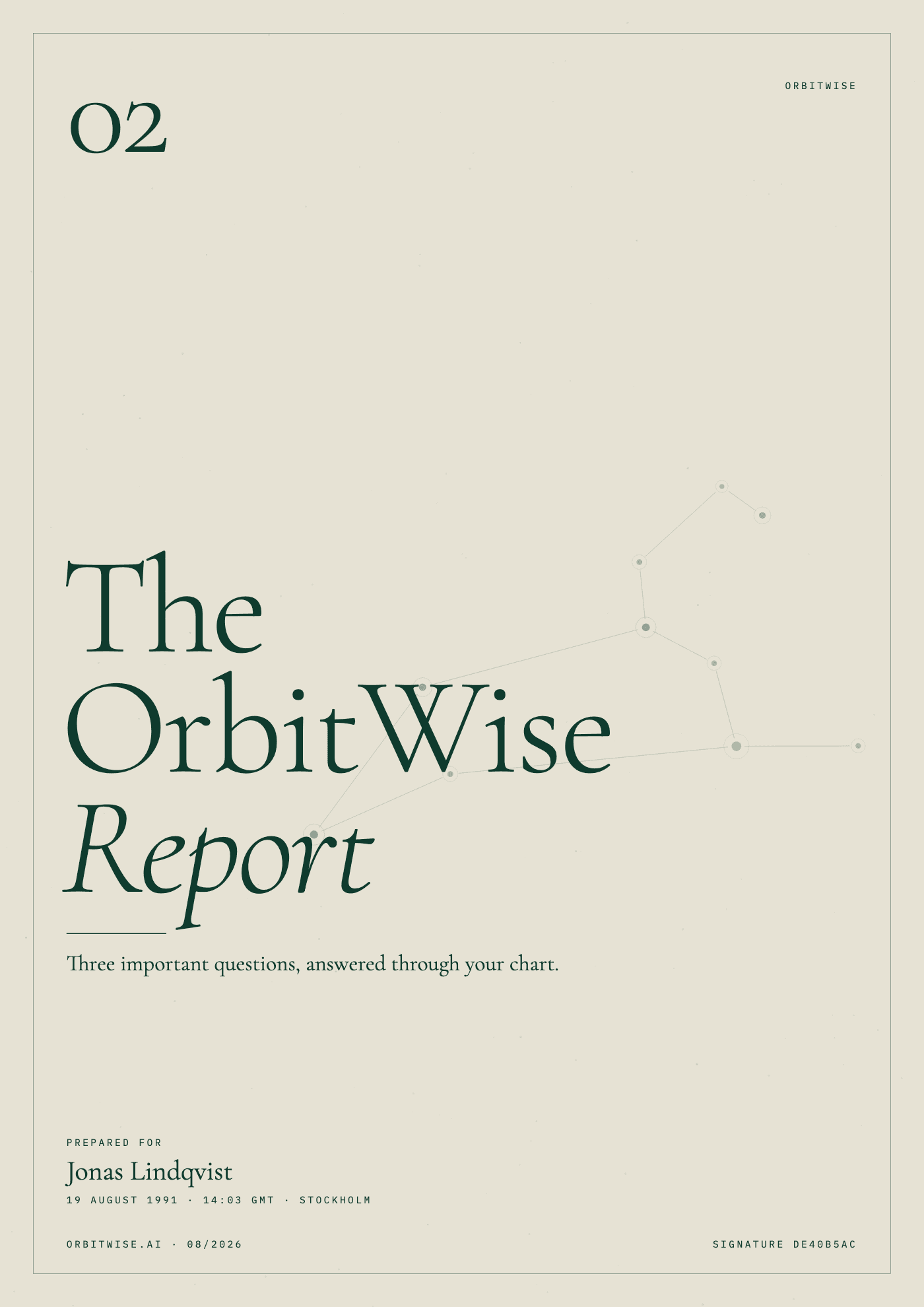
The artefact
The OrbitWise Report
- Three questions chosen by you
- Personal answers grounded in your chart
Bring the question: “Which stream gets my next ninety days?”
No account needed to buy · delivered within 48 hours.