Personal Wealth Indicators & Potential
“How does money actually work in my chart?”
How money arrives for you, holds for you, and leaves you is a chart structure. The Definitive reads your wealth pattern whole: the channels that compound for you and the ones that leak.
Twice the money arrived. Twice the account went back to where it started.
The first time it was a raise. The second time it was the year the work finally paid. Both times you were sensible for a quarter or two, and both times, twelve months on, the balance sat within a rounding error of where it had started. The statement shows you where it went and explains nothing, because the money did not leave through one dramatic decision. It left through the same route it always leaves by.
Nobody can plan against a pattern they cannot name. So you tighten, you budget, you promise yourself the next one will be different, and the next one goes the same way. The second half of a working life is built on what the first half held rather than on what it earned, and most people find out which of those they were good at far too late to do anything with the answer.
Diversifying spreads your money evenly across what holds and what leaks.
Spend less than you earn. Automate the transfer on payday. Diversify, hold your nerve, give it thirty years. The arithmetic is sound and the discipline is real. Every line of it was written to hold true for everybody, which is what makes it silent on the only thing you actually needed: which routes capital has reached you by, and which have taken it away.
Money reaches different people through different routes, and the routes are stable across a life. One person compounds through ownership and loses everything liquid. Another holds a salary well for decades and drains every side venture they touch. A third builds only through other people's capital and reads that as a weakness rather than a channel. The read names which of yours have historically held and which take capital in without giving it back. Name money at intake and the strategic architecture builds its longest section on that answer.
Money also leaves twice. Once as spending, which everyone watches, and once as deployment, which nobody registers as leaving because it is filed under investing. A channel that has never held for you removes capital exactly as a habit does, only slower, with a better story attached and a spreadsheet defending it. That is the half of the pattern a budget cannot see, and it is where the decade goes.
Most people inherit a financial architecture from a person whose capital never arrived the way theirs does.
Capital does not reach every person by the same routes. The read ranks the channels your own chart compounds through, names what each one asks in return, and separates them from the ones that take capital in and give none back. The rows take your own order, set by your birth data, and the money Mirror behind them is a structural portrait of how you hold money and how you release it.
Arriving, holding and releasing are three different acts, and a year does not favour them equally. The ribbon shows which stretches of the twelve months ahead favour committing capital and which favour holding position, and the two are not symmetrical: a committing window missed costs a year, a holding window missed costs the capital. Every stretch is dated.
Drawn from your real chart in OrbitWise Definitive, delivered within 5 days.
Get the DefinitiveWhat almost nobody asks about their own money.
The question people bring is how to earn more. These six decide whether more would have stayed.
The channel you credit, and the one that paid
You credit the work. The money usually came by a different route than the one you were pushing on, and that mismatch is why the next push returns less. Separating the route the money actually came by from the one you were busy in tells you which conditions your capital has held under, which are not always the conditions you worked hardest in.
Which channel pays in a year you did not work hard
The years you coasted and were paid well are the most useful data you have, and the only ones nobody examines, because a good year you did not earn is embarrassing rather than instructive. Effort is the variable you can see, so it takes the credit by default. Take it out and what is left standing is the route: the one that pays whether or not you are pushing on it.
Whether your money is front-loaded or back-loaded
Some structures pay early and thin out. Others pay almost nothing for two decades and then fund the rest of the life. Read across a whole life rather than the year in front of you, the shape is visible, and it decides whether patience is a virtue or an expensive habit for you. Running a twenties strategy into a structure that pays late is how people arrive at fifty convinced they were unlucky.
The people your money leaves through
More capital moves out through relationships than through markets. The loan to a sibling, the guarantee on somebody else's borrowing, the venture you entered because refusing was harder than the money. How you respond to being asked is structural, it has been consistent your whole life, and it is the leak that never appears in a review because it is filed under family.
Whether your money survives being reachable
Some people's capital only holds when it is committed and inconvenient to touch. Others decide badly about money they cannot see, and need it visible and liquid before they will handle it well at all. Those are opposite architectures, and no adviser asks which one you are, because the question is about the holder rather than the holding.
What each of your channels actually pays in
Ownership pays in equity, craft pays in fees, the salaried channel pays largely in access and title. Most people book one as another, so a decade of being paid in something illiquid gets filed as a decade of earning, and the shortfall only surfaces when someone asks what you can actually move. Knowing which currency each channel settles in changes what you accept as payment.
What forty-odd pages say about your money.
The longest section of the architecture
The strategic architecture gives its longest section to the priority you name at intake. Where that is money, this is the part that builds the year around which channels hold for you and which do not.
The money mirror
One of five mirrors, alongside leadership, decision-making, conflict and romantic. Written as a structural portrait rather than a compliment: how you hold money, how you release it, and what you do when you are asked for it.
The front of the report opens on money
The executive summary leads on whatever you name as dominant at intake. Name money and it takes the front position, the secondary priorities follow it, and a quick-wins page closes the front matter.
Where the money sits in a whole life
A hundred-year view of your major periods, a deep dive on the major period you occupy now, and the whole life sorted into three parts. It is what shows whether the route paying you now is the one the next twenty years run on.
The Definitive runs on a long-form sitting, forty-one to forty-seven pages, delivered within five days, cast once on a whole-life foundation with a twelve-month forward horizon. There is no annual re-cast: owners are invited into the quarterly rhythm of the OrbitWise Report instead.
The pattern is stable. The decisions it has to survive arrive weekly.
Which channels compound and which leak has an answer, and the read puts it in writing. Producing it also fixed a record: your chart resolved once, the long-form sitting where you set out what you actually earn from, what you owe, and what you are trying to reach, the money Mirror, and an architecture whose longest section went to the priority you named.
None of that record goes on a shelf. It sits with an astrologer you can put a live question to. A sum lands in March and three things want it at once. Ask whether the stretch favours committing it or holding, and the answer comes back against the route it arrived through and what you told it in February. On whether any of the three is a sound place to put money it has no view, and sends you to your financial adviser.
What your reading learns about you is kept. The next thing you read starts from everything the last one knew.
Aster runs on a monthly plan. The deeper readings include a run of free days with him, and the credits the plan gives you each month go toward your next Report. Subscriptions are not open right now. See what Aster costs.
Our position.
Free will and personal choices matter most. What you earn, what you refuse, what you sign and what you keep quietly paying for are decisions taken by you, in your own week, and this read moves none of that off your desk.
Terrain is what this offers, and terrain is not destiny. It names which channels your capital has historically held in, and which stretches of the year favour committing or holding. The allocations stay yours: naming a route that has never held for you does not close it, and nothing here decides what you fund next. What changes is that a flat year stops being read as a verdict on the person having it.
And it is one instrument among several. Your accountant knows what the year owes, a tax adviser knows what the structure costs, a financial planner knows how an allocation should be weighted, a valuer knows what the asset is worth, and an estate lawyer knows who ends up holding it. Take all of them. Every plan they draw is then run by a person with a fixed set of routes and a long record of which ones held.
The artefact
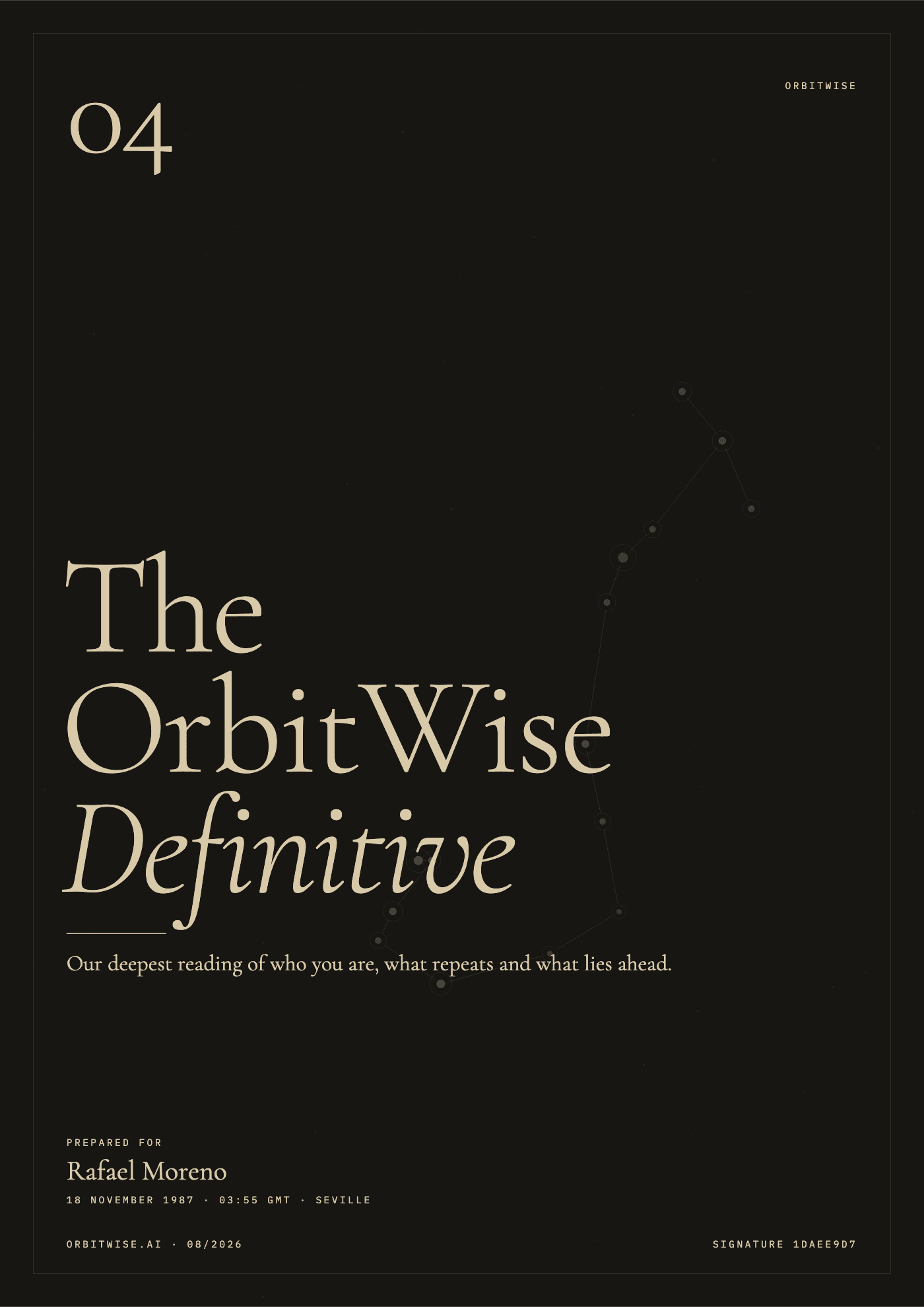
OrbitWise Definitive
- Your major life periods
- The next twelve months in depth
Bring the question: “How does money actually work in my chart?”
No account needed to buy · delivered within 5 days.