Intrinsic Risk Tolerance Profiling
“What risk am I actually built to hold?”
Your appetite for risk under pressure is not what you say it is. The Definitive's money and decision Mirrors read it structurally, so you know the operator you are under pressure rather than the one you imagine.
How much financial risk can I actually handle?
That question contains two different questions, and separating them is most of the work. The first is capacity: how much you can lose without damaging your obligations. That is arithmetic. It is answered from your income, your reserves, your dependants and your debts, and it belongs with a qualified financial adviser and your own numbers. Astrology has nothing to add to it.
The second is temperament: what you actually do when a position moves against you, when a decision is public, or when you are asked to hold something uncertain for a year. That is behaviour, and it is where an astrological reading can offer something. It can describe a disposition, in the sense of a tendency the tradition associates with your chart, which you can then compare against how you have in fact behaved.
The reason the second question matters is that most people answer it wrong about themselves. Stated risk tolerance is measured while calm. The tolerance that decides outcomes is the one available at the worst moment. A reading is one way of examining that in advance, as an interpretation to test rather than a measurement to trust.
What the reading is describing, and what it is not.
A reading of disposition works from your own birth chart. For money questions the houses conventionally consulted include the second for wealth and resources, the eighth for transformation and other people's money, and the eleventh for gains and networks. The tradition also associates particular planets with appetite and restraint, Mars with initiative and Saturn with caution among them.
Those are conventional significations inside an interpretive tradition. They are not measurements of your psychology, and they carry no predictive authority over your account balance. What a reading produces is a description you are free to reject, and the honest test of it is whether it matches episodes you can actually remember.
Alongside the chart itself, a deeper reading considers the longer planetary periods, calculated as a fixed sequence from your birth, which run from six to twenty years and subdivide into shorter spans of months to a few years. That layer is read for the chapter you are in rather than for any single decision, which is the appropriate resolution for a question about temperament.
A worked example.
An invented person, written to show the reasoning. Not a customer, and not a result.
Take an invented investor who describes himself as comfortable with volatility, and who has twice sold a long-term holding within a week of a sharp fall. He has recently been offered a position that would take four years to mature.
Suppose his reading emphasises initiative and speed in the placements traditionally associated with resources, with a weaker emphasis on the significations of patience and endurance. A reader might interpret that as a disposition that enters positions readily and finds the holding phase, rather than the loss itself, the genuinely difficult part.
The practical use of that is not an allocation. It is a design decision. If the difficulty is holding rather than losing, then the useful response is structural: pre-commit the exit rules in writing before entering, reduce how often the position is visible to him, and treat any decision made within a week of a fall as one requiring a second signature. The interpretation does not tell him what to buy. It tells him which of his own habits to build a fence around.
It is also checkable, which is the point. He has two remembered episodes to compare it against. If the description does not fit them, it should be discarded rather than believed because it came from a chart.
What a reading needs, and where it stops.
What a reading needs from you
- Your date, time and place of birth, with a note if the time is uncertain.
- An honest account of what you have actually done under pressure, not what you intended to do.
- The decision or pattern you want to understand, described specifically enough to be checked later.
What it can reasonably give you
- A description of the disposition the tradition reads in your chart, in ordinary language.
- The recurring behaviour it would expect under pressure, which you can test against your own history.
- The longer chapter you are in, so a temporary reaction is not mistaken for a permanent trait.
What it cannot do
- It is not financial advice, and it is not regulated as such.
- It cannot size a position, recommend an allocation, or forecast a return.
- It cannot establish your capacity to bear a loss. That requires your actual finances and appropriate professional advice.
- Overcoming subconscious financial blocks if the pattern is avoidance rather than appetite.
- Personal wealth indicators for how the tradition reads money in a chart more broadly.
- OrbitWise Definitive the whole-life reading, including what repeats and the major periods.
- Breaking Patterns a focused reading for one recurring behaviour.
You discover your real risk tolerance at the exact moment it costs the most.
The number goes red on an ordinary morning and you check it at eleven, then at one, then in a meeting you have stopped listening to. By Friday you have either sold into the fall or put more in to make the feeling stop. Neither move was in the plan you wrote when the position was quiet. Both felt like judgement at the time.
Every questionnaire asks you to rate your appetite for risk, and you answer it on a quiet afternoon with a coffee. Nobody is tested on a quiet afternoon. What you can hold gets decided months later, at two in the morning, against a number you did not expect. The gap between those two answers is not a quirk of temperament. It is the size of the position you should never have taken, and it gets paid in full.
Only risk what you can afford to lose measures the wrong account.
The advice is consistent wherever you get it. Size against what you can afford to lose, diversify so no single holding can hurt you, hold through the drawdown, and stop looking at the screen. It is competent, and it is aimed entirely at your balance sheet, which is the account that never panics. A balance sheet is still entirely intact at the bottom of a bad week. The person holding it sells anyway.
Risk tolerance is two separate faculties filed under one name. Appetite is what you are willing to enter, decided in daylight by the part of you that likes the idea. Holding power is what you can sit through while it is losing, alone, at hours nobody scheduled. Your planner means the balance sheet by capacity. This is the other capacity, and two Mirrors carry it: decision-making, which takes how you act on thin information against a clock, and money, which takes what your conduct becomes once it is losing. Read as a pair, they describe what you can sit through, which is the half of the question your planner is not measuring.
Which is why the post-mortem almost never finds the real error. You sold nine days early, and the file records a call on the fundamentals, so next time you research harder and build a better thesis. A better thesis does not extend your holding power by a single day. It gives you a more articulate reason to exit at the same point. The correction that works is knowing what you can sit with before you take the position rather than discovering it inside one, so that whatever size you and your planner settle on is set against the person who will actually hold it.
Every position is sized for a version of you that does not survive week three.
Not every kind of loss costs the same to carry. The decision-making and money Mirrors are structural portraits rather than encouragement, and between them they name what each kind of loss asks of you and which of them you are actually built to sit through. Both are drawn against the birth data you give at intake and the long-form sitting behind it.
Your holding power is not constant across a year. The Definitive lays the twelve months ahead out as major transitions, a dated quarterly strip and four quarterly deep dives, naming the stretches that favour a position taken with conviction and the ones that press hardest on the person holding it. Every window it claims carries dates.
Drawn from your real chart in OrbitWise Definitive, delivered within 5 days.
Get the DefinitiveThe questions a risk questionnaire cannot reach.
A number on a form describes the person filling it in. These six are about the person still holding the position in month four.
What a gain does to your judgement
Every plan is written for the loss. Nothing prepares you for the position that has doubled and is now the largest thing you own by accident. A paper profit is a load in its own right: it changes what you are willing to risk, it makes the next decision bigger than the last one, and it is the untested half of almost every risk profile ever written down.
Whether you can hold it in public
A position you have told nobody about is a financial decision. The same position, mentioned once at dinner, becomes a reputational one, and the two are held by different faculties. Some charts carry being visibly wrong for a year without flinching. Others close a good position early rather than keep explaining it, and the tell is never the loss, it is who was told.
Losing, or not knowing
These are not the same intolerance, and the fix for one makes the other worse. If what you cannot sit with is the number moving, the answer is smaller and slower. If what you cannot sit with is the open question, volatility is survivable and it is the illiquid, long-dated position that breaks you, however sound it is. Most people lower their risk when they should have shortened their horizon.
Which injury is running your entries
You can be strongly averse to losing money and still enter late and oversized, because the two injuries pull in opposite directions and only one of them is loud. Treating the one you can name makes the one you cannot worse. Which of the two is actually setting your entry size is a fact about how you are built, not a mood, and it has been setting it for years.
The six months after the loss
The loss gets priced on the day it happens. The caution after it gets paid for across the next six months: the sitting out, the smaller size, the opportunity taken at half the conviction it deserved because the last one hurt. Some people are back to full capacity inside a week and others carry one bad position for a year, and that recovery time is worth knowing before you decide how much to carry in the quarter after a bad one.
Who else is reading the number
You are not carrying the position alone. A partner who checks the balance, a parent who lost something once and said so often enough that you can still hear it, a household that will feel a bad year differently from you. Holding power drops sharply when the number is being read over your shoulder, and this is the variable people size around silently rather than name at the start.
The pages that answer what you are built to hold.
The two Mirrors that decide it
The money Mirror reads what your conduct with money becomes once it is losing. The decision-making Mirror reads how you act on thin information against a clock. Each is a structural portrait rather than advice, and what you can sit through comes out of holding the two against each other.
A summary weighted to what you came for
The front of the report opens on the priority you name at intake. If the question is what you can carry, it leads the executive summary, the secondary priorities follow, and a quick-wins page closes the front matter.
Where you stand this month
The present read at four layers, a thirty-day outlook and the week ahead. It is what tells you whether the pressure on you this week is a stretch you are passing through or the real edge of what you hold, and it is read before you commit to something this month.
The twelve months, quarter by quarter
The year's major transitions, a dated quarterly strip, and four quarterly deep dives running forward from the cast date. The forward horizon is twelve months, which is longer than most positions give you to think.
The warnings, and what load does to the body
A warnings page written against your chart, and a health vigilance page drawn from the optional health context you give at intake. Carrying risk is physical before it is financial, and the report treats it that way.
The sitting behind all of it
Not a ten-minute questionnaire. A long-form prose account of yourself alongside structured blocks: your dated life events, your goals, an optional health context, and the priority allocation that decides what the report leads on. The back matter carries the methodology, glossaries and appendix.
The Definitive is cast once: a whole-life foundation with a twelve-month forward horizon, forty-one to forty-seven pages, delivered within five days. There is no annual re-cast. Owners who want each quarter read as it arrives are invited into the quarterly rhythm of the OrbitWise Report instead.
Your holding power is only ever tested after the report is on the shelf.
The read answers what you are built to hold, and says it in writing. Producing it also puts the material on file: your chart resolved once, a long-form sitting in which you described your own conduct with money, two Mirrors written for you and meant to be read as a pair, twelve months laid out with dates. Reading the answer does not consume any of that.
An astrologer reads those same two Mirrors when you write in, so what comes back is aimed at the person holding the position rather than at the position. A holding has moved hard against you and you have not slept in eight days: ask whether this is the edge your read named or a stretch you are passing through. On whether to sell, or what it is worth, it holds no view, says so, and sends you to an adviser.
What your reading learns about you is kept. The next thing you read starts from everything the last one knew.
Aster runs on a monthly plan. The deeper readings include a run of free days with him, and the credits the plan gives you each month go toward your next Report. Subscriptions are not open right now. See what Aster costs.
Our position.
Free will and personal choices matter most. Every position in your name was opened by a decision you took and will be closed by another one. The discipline to sit through a drawdown, and the honesty to admit when a holding has become larger than you, belong entirely to the person holding it. This read carries neither for you.
What this maps is what you are built to carry, not what you happen to be carrying. It describes the capacity a specific person has, and which months will lean on it hardest. Nothing in it forecasts a price, and nothing in it says a position will recover. What changes is that a bad fortnight stops being read as evidence that you were wrong, and a run of easy months stops being read as proof that you can carry more.
And it is one instrument among several. Your financial planner sets the allocation, your accountant and tax adviser price what selling costs, your lender tells you what the covenants permit, and a valuer tells you what it is worth. If a loss has taken your sleep, a therapist is a serious answer. All of them size against the money. None of them is scoped to measure the person who has to sit with it.
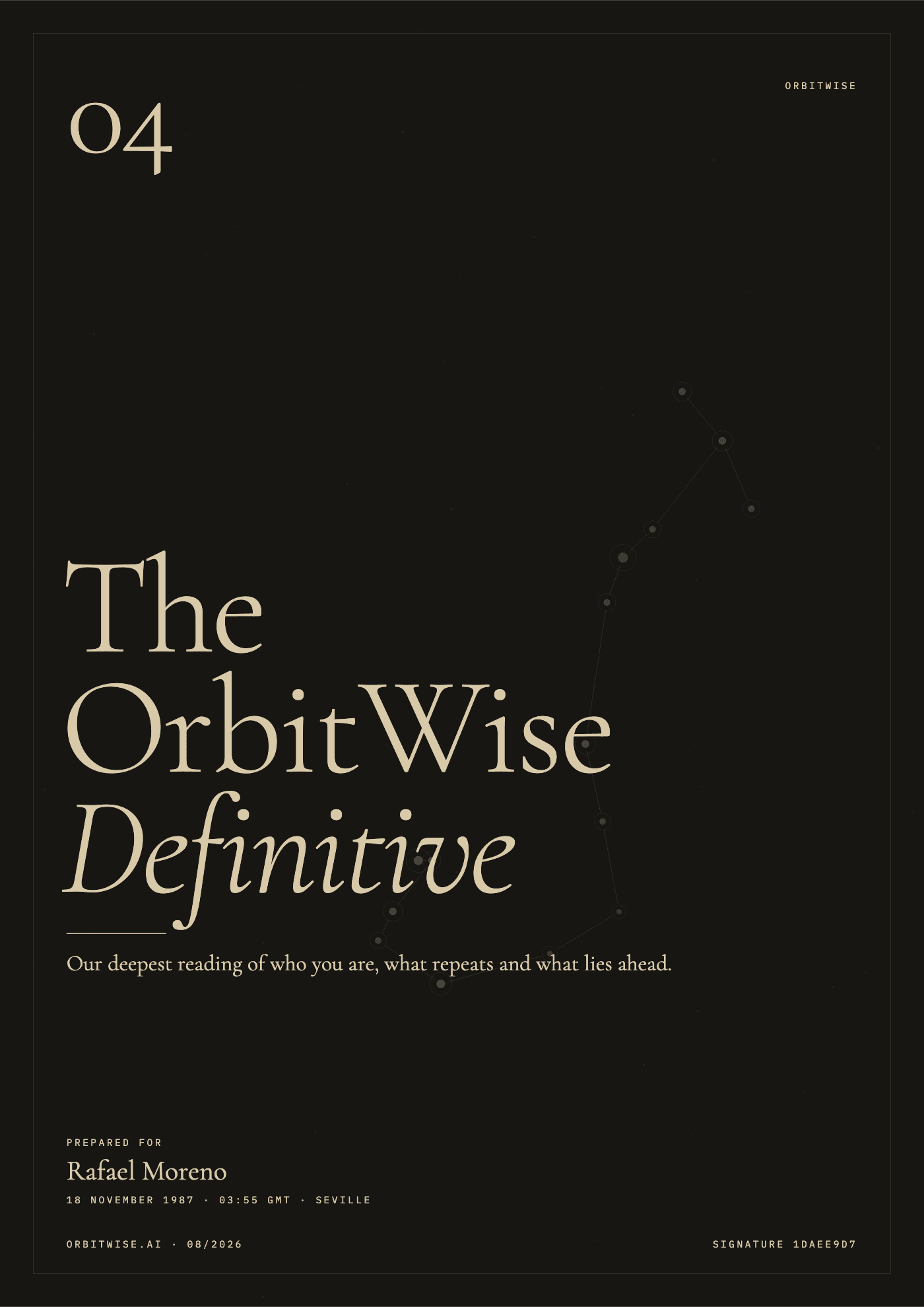
The artefact
OrbitWise Definitive
- Your major life periods
- The next twelve months in depth
Bring the question: “What risk am I actually built to hold?”
No account needed to buy · delivered within 5 days.