Partnership Equity & Profit Sharing
“Is this split built to survive success?”
Splits fail on dynamics, not on maths. OrbitWise Synastry reads your chart against your partner's, with their consent, and shows where the money conversation between you actually lives.
The split you agreed in an afternoon will price every year after it.
You agreed the split early, over one long conversation, when the thing was still an idea and the money was still hypothetical. An even cut felt clean and generous. A tilted one felt honest about who was doing what. Neither of you was arguing over a number that existed yet. Then it worked, and the number you barely negotiated became the one you think about on a Sunday.
It does not announce itself. It shows up as an expense you do not query, because querying it opens something. As a purchase of theirs you price against your own share without meaning to. As a good month that goes strangely quiet between the two of you. Nothing has gone wrong and nothing is sayable, and you are running arithmetic in your head through conversations that were supposed to be about something else.
You papered the breakup. Nobody papers the windfall.
The counsel is uniform: agree it early, vest everything, put a deadlock clause in, decide how you separate while you still like each other. A partnership agreement is a set of instructions for a partnership that is failing, written by people who have watched partnerships fail.
Failure is the simple case, because it removes the choices. Everyone gets less and the document already says what happens. Success does the opposite. Money arrives with a hundred decisions attached and nothing signed about any of them: what gets drawn, what gets held, who buys what with their share, whose spending the other now has to watch. An even split is a bet that two people will want the same things from money across a decade in which neither of you stays the same person.
The paper aims at the downside because the downside is the only part a document can know in advance. What each of you does with money you did not expect is knowable in advance too, from somewhere else. Two charts read against each other put those defaults in front of you before the first good year does: not a label for a temperament, a ranked list of the specific contacts between two specific people. The strain still comes. It comes named, and early.
Nobody has ever resented a split that paid nothing.
The unit here is neither chart on its own, it is the contact between them. Every drawn contact is a named bond, heaviest where it binds tightest, and a heavy one is no promise that the bond is a comfortable one to own something jointly through. Both charts come from the birth details you supply for each of you, and neither is guessed from a description of the partnership.
No compatibility score, ever, and no bond filed as good or bad. Every contact between the two charts is found, ranked by how tightly it binds, and the dominant one named outright even when it is not the tightest by that measure. Each is read for which of the two of you actually pays for it.
The conversations that move money between two owners have better and worse months: one of you borrowing against the thing to buy a house, a new ratio on what gets taken out, a child added to the register. The report names two to four dated windows across the twelve months ahead, each closing on an action with a date rather than on a mood.
The questions two owners skip and then pay for.
The question that gets asked is whether the split is fair. Fairness is a comparison, and it moves the moment the money does. These six are about what each of you does when there is more of it than either of you planned for.
01 · Which of you has been keeping countIllustrative
What the report puts in front of the two of you.
01 · The bonds, ranked tightest firstIllustrative
Read with consent. One of you buys and answers for both; you attest to your partner's consent at intake, and only you receive the report.
An equity split is not settled once. It is retested by every good year.
The report answers whether the arrangement holds. Producing it also builds the record: both charts resolved, every bond between you ranked, each with the side of it that costs somebody, and twelve months of dated windows. The document is that read on the week it was written. The material underneath it is not tied to that week.
The report is the part you read. Behind it the pairing stays open with an astrologer, and each question you bring adds to it. Eighteen months on, a strong year: your partner wants the surplus reinvested and you want it drawn. Ask when to put that and how they will hear it, and it answers from the bonds already named. Whether the drawing is sound, or what a re-cut costs in tax, is your accountant's, and it says so.
What your reading learns about you is kept. The next thing you read starts from everything the last one knew.
Aster runs on a monthly plan. The deeper readings include a run of free days with him, and the credits the plan gives you each month go toward your next Report. Subscriptions are not open right now. See what Aster costs.
Our position.
Free will and personal choices matter most. The split is agreed by two people who could each choose differently tomorrow, and the read does not sign, concede, or hand anything back on your behalf. Everything consequential in a partnership is said by one of you to the other, and this report is not present for any of it.
None of this is fate, and none of it is a forecast. It describes how two specific people are built around money and when the pressure between them rises, which is a map of the pair, not a ruling on what you do with it. People who know the ground still negotiate every number themselves. They simply have the argument early, with the pressure named, instead of late, with a windfall sitting between them.
And it is one instrument among several. Have a lawyer draft the mechanics, your accountant price what a re-cut costs in tax, an independent valuer set the number if one of you is buying the other out, and an estate lawyer say what happens to a share when one of you dies. Each of those is work on the document. What the two of you do with money in a good year is outside every one of those briefs.
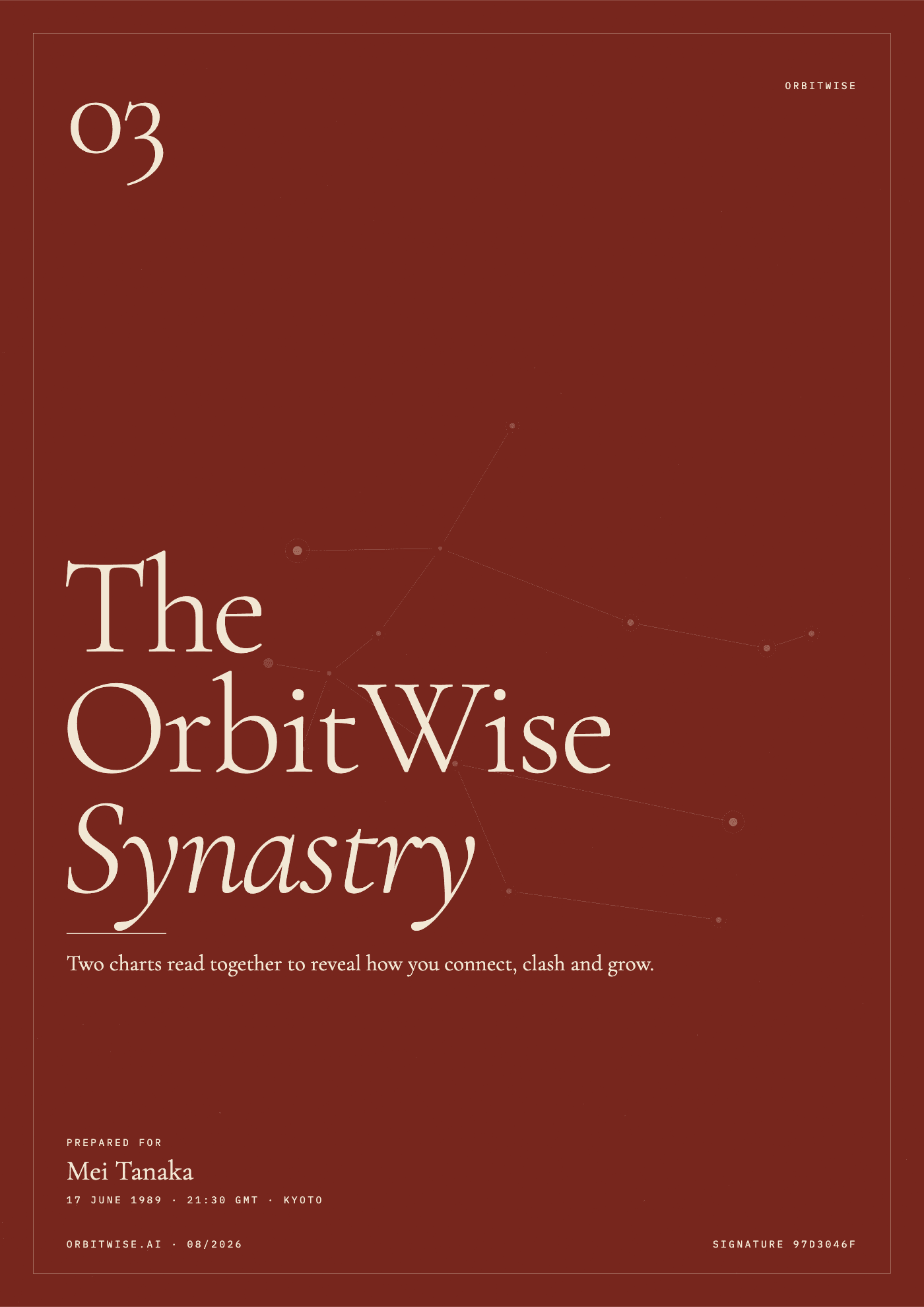
The artefact
OrbitWise Synastry
- Two charts read together
- Connection, tension and recurring dynamics
Bring the question: “Is this split built to survive success?”
No account needed to buy · delivered within 3 days.