Generational Wealth & Legacy Planning
“What outlives me, and what do I owe it now?”
Legacy is a whole-life question and it gets the whole-life document. The Definitive reads what you are building past yourself, and what the structure asks you to put in place now.
You spend decades building it and one afternoon handing it over.
The documents are the straightforward part. A will takes an afternoon, a structure takes a few weeks, and both settle where things go without settling anything about what happens next. Money moves on a date. Readiness to hold it moves on nobody's schedule, and it is not written into the deed.
Then there is the version nobody prices: the thirty years you keep hold of the money because handing it over feels premature every time you consider it. Whoever is waiting learns to wait rather than to decide. What you leave arrives intact and lands on someone who has never once had to make a call about it. Families rarely lose it to a market. They lose it to a handover nobody rehearsed.
Estate planning dates everything from your death. The decision is dated from your life.
Start early. Put it in a structure. Diversify out of the single asset. Teach them about money before they have any of it. Write the will, hold the family conversation, keep it all current. None of that is bad advice, and all of it plans the asset. The asset was never the fragile part. Each of those instruments is dated from an event you will not be present for. The harder question is dated from your life, and no checklist contains it: when do you stop being the one who holds it.
A life is not one continuous run. It divides into a small number of chapters with joins between them, and each is built for a different job: one for accumulating, one for consolidating what accumulated, one for release. A hundred-year view of your own periods sorts them and names where the joins fall. That is the layer succession runs on, because a handover is not an asset moving between accounts. It is a role being vacated, and the role belongs to a chapter.
The instinct is to wait until it is obvious. It becomes obvious late. The chapter a handover belongs in opens while you are still fully capable, which is exactly why it goes unused: stepping back at full strength reads as premature to everyone, including you. Chapters do not announce themselves. By the time the evidence is loud enough to act on, the handover is happening under pressure, on a date somebody else chose.
Succession is not a document you leave behind but a decade you spend while you are still here.
The hundred-year period view sorts a whole life into three chapters and names where the joins fall. Which of them is built for a handover follows from what each chapter is for, and it is rarely the one your age would nominate. Sorted from your own periods, with the twelve months ahead arriving dated.
Succession is a decade-long question that gets settled in particular weeks. The twelve months ahead arrive as major transitions, a dated quarterly strip and four quarterly deep dives, naming the stretches that favour handing something over and the ones better spent teaching how to hold it. The dates sit here.
Drawn from your real chart in OrbitWise Definitive, delivered within 5 days.
Get the DefinitiveWhat nobody asks while the will is being drafted.
The question arrives as who gets what, and by when. These are the six underneath it, and not one of them is settled by a document.
Whether you are still the one who builds it
Age is the proxy everyone uses and it is a poor one. Some people are handed the years for release at fifty-two and spend them expanding, because the calendar says they are early. Others step back at forty from something still in its accumulating stretch and spend two decades watching it be run smaller. The question is which chapter the coming years belong to, and it is answerable before the evidence arrives.
What year it is for whoever receives it
A transfer lands inside a life already in motion. Money arriving in somebody's building years does a different thing from money arriving once they are consolidating, and the tells need no chart: whether they are still taking on commitments or shedding them, whether the largest one is ahead of them or behind. The first gets deployed. The second has to be held, and holding is the part nobody teaches.
What they inherit before the money
Successors take on a posture years before they take on a balance. The one who watched you refuse to sell in a bad decade will refuse to sell in a bad decade. The one who watched you keep the numbers private will keep them private from their own children. That transmission happens whether or not it is planned, and it is the part of the estate no document allocates.
The gap between stepping back and being succeeded
These are two acts and they are usually years apart. You stop making the calls, nobody is yet making them instead, and the thing runs on the momentum of decisions taken while you were still deciding. A portfolio, a property, a company: each spends that stretch compounding at the rate of decisions nobody has refreshed. Both dates are yours to place, and only one of them normally gets planned.
The inheritance running the other way
You are also somebody's succession plan. A parent's business you are expected to take, a sibling who is not going to earn, a house nobody will sell, money that arrives at a moment you did not choose. A good deal of what looks like your own building is an obligation inherited upward, and the years ahead treat the two differently. Worth separating them before you make plans on top of both.
Whether it is meant to outlast you at all
Some things are built for one chapter and are complete when it closes. Forcing continuity onto them costs twice: the thing is held past its useful life, and whoever inherits it spends their own years maintaining somebody else's. The honest version of the question is not how to make it permanent. It is which part of what you built is meant to run on without you, and which part you are allowed to finish.
What the long arc actually puts on the page.
A hundred years of your periods
The full sequence of your major periods laid out across a hundred-year view, so the decade you are in has something to be a decade of. This is the section that separates a slow stretch from a closing one.
Your life in three chapters
The whole arc sorted into three bounded chapters with the joins named: what each one is for, and where one hands over to the next. Succession questions take their answer from here rather than from your age.
The current major period
A deep read of the major period you occupy now: what it rewards, what it taxes, and how long it runs. The layer that explains why an approach that served for twenty years stopped returning, with nothing visibly different about it.
The twelve months, quarter by quarter
The year's major transitions, a dated quarterly strip, and four quarterly deep dives running forward from the cast date. The forward horizon is twelve months, which is where the transfers, the conversations and the signatures actually get placed.
The near ground
Where you stand at this moment read at four layers, with a thirty-day outlook and the week ahead in detail. The short horizon exists so the long arc has somewhere to touch down.
The closing letter
The document does not end on a checklist. It closes in a contemplative register, written to you, on what the arc adds up to and what the years ahead ask of what you are building. The methodology, glossaries and appendix follow it.
Cast once, on a long-form sitting, forty-one to forty-seven pages, delivered within five days. There is no annual re-cast by design: owners who want the year read quarter by quarter move into the quarterly rhythm of the OrbitWise Report instead.
Succession is signed in a week and then tested for the next thirty years.
Whether the years ahead are for building or for handing over gets answered in writing. Answering it also puts the arc on file: your chart resolved once, a hundred years of periods, the three chapters and their joins, and what you said at the sitting about who is waiting and what you believe you owe them. The pages are one use of that material, not the end of it.
The arc does not close when the report does. Everything under the report is still there, and a question can be put against it. A child asks for the house years before you meant to offer it. Put that to it and the answer is worked against the chapter your read named and the join it says is coming, not the month they asked in. On the structure it sends you to your estate lawyer, on the tax to your tax adviser.
What your reading learns about you is kept. The next thing you read starts from everything the last one knew.
Aster runs on a monthly plan. The deeper readings include a run of free days with him, and the credits the plan gives you each month go toward your next Report. Subscriptions are not open right now. See what Aster costs.
Our position.
Free will and personal choices matter most. The savings exist because somebody decided not to spend them. The house came through a bad decade because somebody decided not to sell it. The conversation with your children will be had by you or by nobody, and no part of this read takes a minute of that off you.
This is terrain rather than destiny. It names which chapter you have reached, what that chapter is built for, and where its joins fall. People who know the terrain still decide every transfer themselves. What it settles is which of those transfers is a chapter question and which is only paperwork with a date on it.
And it is one instrument among several. Your estate lawyer drafts the instruments, your tax adviser prices the timing, an accountant and a valuer put a number on what is moving, and where a family is involved, somebody whose job is the conversation rather than the assets. Every one of them works to the document. None of them asks which decade of your life you are signing it from.
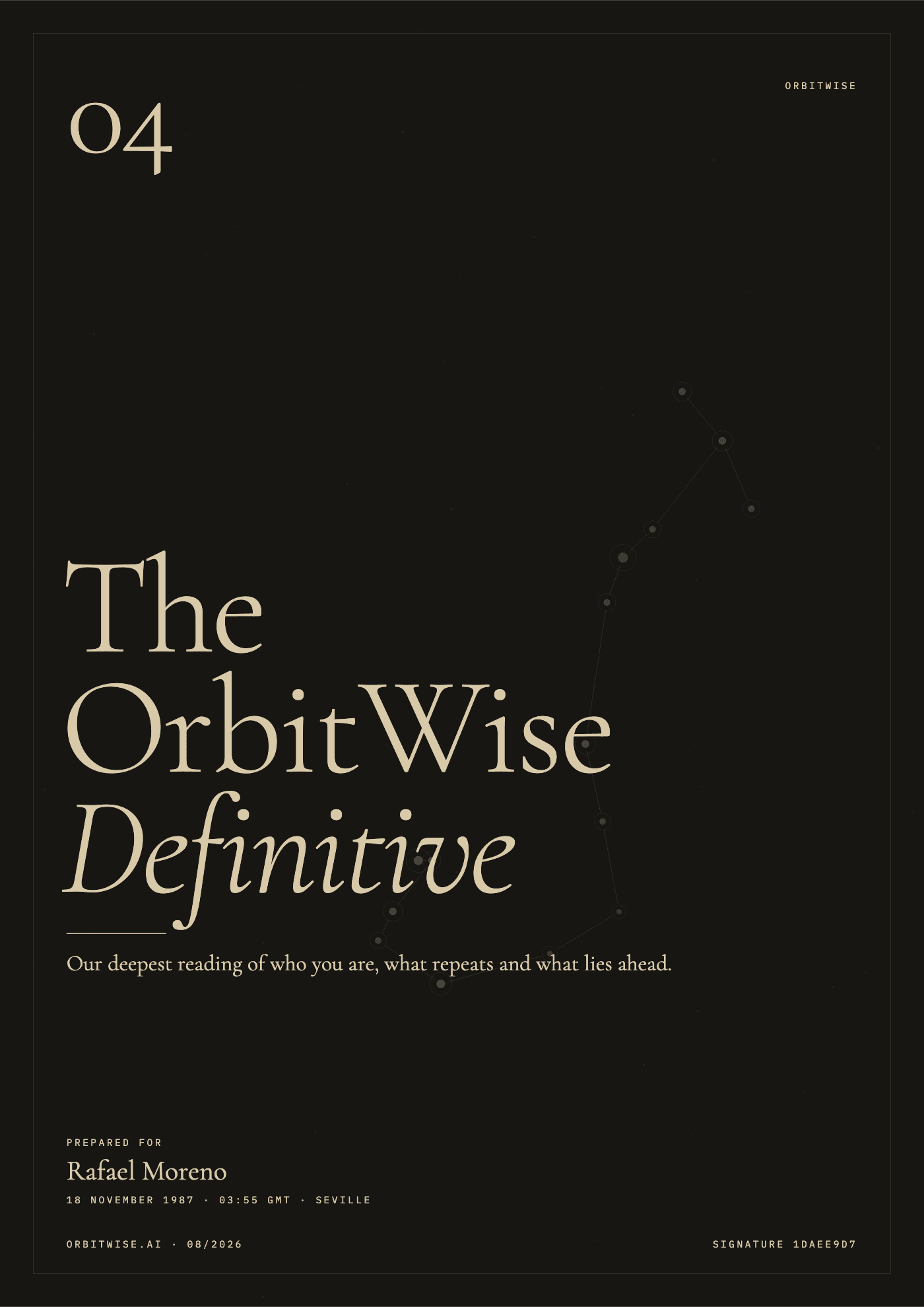
The artefact
OrbitWise Definitive
- Your major life periods
- The next twelve months in depth
Bring the question: “What outlives me, and what do I owe it now?”
No account needed to buy · delivered within 5 days.