Crisis Management & Downside Protection
“What do I protect first, and how long does this weather last?”
In a crisis you need answers fast and you need to know how long this lasts. The OrbitWise Report answers your own most urgent questions within 48 hours, then bands the ninety days behind them so you can see where the pressure eases and where it does not.
In a crisis everything is urgent, and you cannot defend all of it properly.
Something has given way. The funding, the diagnosis, the counterparty who has stopped answering, the letter from someone else's lawyer. Several things are at risk at once, each with a person attached asking you for an answer today, and you are making calls on three hours of sleep with half the facts in.
Then there are the decisions made while the damage is still loud: the cut taken too deep, the message sent at midnight, the concession given away to end a phone call. Advice arrives at volume in a crisis, all of it confident, none of it dated, and none of it accountable for what it costs you in week three.
Triage assumes you already know which one is dying.
Stabilise the cash. Tell the truth early. Make no irreversible decisions until the dust settles. Sound as posture, useless as a sequence: none of it tells you which of the things under threat is load-bearing, and none of it tells you how long the pressure runs. The dust settles is not a date, and you are being asked for answers on a calendar.
What replaces posture is a horizon with dates on it. A chart read against a named ninety days does not tell you the crisis is survivable. It tells you where inside those ninety days the pressure sits heaviest, which days rank steady enough to carry a hard conversation, and which specific dates favour the calls you cannot take back. That turns until the dust settles from a stance into a calendar you can plan a payroll against, and it turns your own most urgent questions into dated answers rather than opinions.
The thing screaming at you is rarely the thing to defend. The loudest damage tends to be the damage that burns itself out, while the quiet line item, the one licence, the one client, the one relationship you have stopped returning calls on, is the loss you cannot reverse later. Attention in a crisis flows towards noise by default. Protection has to be assigned deliberately, and early, because the cheapest options are usually the ones that close first.
Every crisis takes something, and your only real choice is whether you chose it or it chose itself.
A crisis is never one thing, it is several arriving together and competing for the same week. The read takes the pressures you name in your own questions and answers each on its own page, dated and prescriptive, then ranks the ninety days themselves into peak, strong and steady bands. Your report draws this from your real birth data, cast and verified before a word is written.
The next ninety days are not flat, and in a crisis the gap between week one and week three decides what the same decision costs. The report ranks your quarter into peak, strong and steady bands, measured within your own ninety days rather than against an absolute scale. Two or three protected windows are then named inside it with specific dates, drawn from your birth data and the days you are actually about to live.
Drawn from your real chart in The OrbitWise Report, delivered within 48 hours.
Ask my three questionsWhat nobody asks while the phone is ringing.
The OrbitWise Report answers three questions of your own, alongside five short context questions it always asks. The instinct is to spend every one of your own on how bad is this. These six are the ones worth writing instead.
What to let break
Not what to save. Which of the things under threat you are deliberately choosing to let fail, so the loss is a decision you made rather than the residue of where your attention happened to go. Almost nobody makes that call out loud, which is how the sacrifice ends up being made for them, late, by whichever pressure ran out of time first. Write it as one of your own and the answer comes back dated and prescriptive on its own page.
Where the month is heaviest
Whether the pressure sits in the opening weeks or the closing ones, and where inside the quarter it eases enough to carry a hard conversation. That shape is on the ninety-day calendar for every buyer, ranked within your own window, and it decides whether you are bridging towards a better week or acting into a worse one.
Who is watching you decide
A crisis is a temporary event that people form permanent opinions during. Your team, your board, your counterparty and your family are all watching you handle something you will handle once, and what they conclude about your competence outlasts the emergency by years. Worth writing down: what your conduct under this specific pressure looks like from outside, and which of those audiences you should be managing deliberately rather than by accident.
Who you call, and in what order
Under pressure people call whoever they trust emotionally first, which is almost never the call that changes the outcome. Sequence matters more than content here: one conversation held before the others reframes every conversation that follows it, and the same conversation held after them becomes an apology.
The decision you are folding in
Crises manufacture permission. The pricing change, the exit, the person you have wanted to let go for a year, all of it becomes easy to move under cover of the emergency. Ask which of this quarter's calls the situation genuinely forces, and you get a direct answer rather than the licence the emergency is quietly offering you.
What you are repricing while you cope
A crisis reprices you in other people's ledgers while you are busy elsewhere. The client who now expects the discount you conceded to end a phone call, the lender who has watched you ask, the colleague who covered for you twice and has started counting. None of it arrives as an invoice this quarter, and all of it is set this quarter, which makes the concessions worth putting to the read: the ones the season genuinely wants from you, and the ones it can survive you refusing.
What the read actually names.
Your own questions, in your words
You write them yourself, free-form, not from a menu, alongside the five the report always asks. In a crisis you already know what you need to ask, and the ones you choose become the spine of the document.
An answer per question, one per page
Each question answered directly on its own page, dated and prescriptive: what to do, and when. No deflection into general chart description, and readable by someone who has never opened an astrology book.
Ten dated imperatives
Five things to do and five to avoid, each carrying a date rather than a mood. In a month where everything feels urgent, a list that says which five actually are is the difference between triage and reaction.
The ninety-day calendar
Your quarter ranked into peak, strong and steady bands, month by month. The ranking is relative to your own ninety days, never an absolute scale, because an absolute scale flattens a strong period into uniform green and tells you nothing about which week to move in.
Three protected windows
Named windows inside the quarter with specific dates, for the calls that should not be made on the day the news lands. Every claimed window carries a date, never a season.
Delivered within 48 hours
Twenty to twenty-five pages, produced and delivered within twenty-four hours of your intake. A crisis read that arrives next week answers a question you have already been forced to answer alone.
The OrbitWise Report is cast for the ninety days from your cast date and is designed to be re-cast each quarter on the data you have already given. When the question stops being this crisis and becomes why this keeps happening, the Definitive is the document for that.
A crisis moves its own dates. The document that ranked them cannot.
Your pressures, named in your own words while they were still live. Ninety days ranked against each other. Your birth data resolved into a chart that stays resolved, and the reasoning under every date the report protected. The report was written out of that material. Reading it does not use the material up.
The report is cast once a quarter. The material under it keeps working in between, put to an astrologer that has your chart, your questions and whatever you have raised since. The counterparty comes back with a number and wants a call by Friday: ask whether Friday carries that conversation or whether the week after holds it. Whether the policy responds, and what you say while that is decided, belongs to your insurer and your communications adviser.
What your reading learns about you is kept. The next thing you read starts from everything the last one knew.
Aster runs on a monthly plan. The deeper readings include a run of free days with him, and the credits the plan gives you each month go toward your next Report. Subscriptions are not open right now. See what Aster costs.
Our position.
Free will and personal choices matter most. No chart has ever renegotiated a covenant, made a payroll, sat through a diagnosis, or told a team the truth on a Monday morning. People do that, and no part of this read makes one of those calls on your behalf.
What the read offers is terrain, not destiny: which stretches of these ninety days favour a hard call, and which ones will not carry one. People who know the terrain still make every decision themselves. They just stop reading the worst week of the quarter as the verdict on all thirteen, and stop spending week one defending something that was never going to break.
And it is one instrument among several. Call your lawyer before you call anyone, get your accountant into the actual numbers, take your doctor's read on what the last month has done to you, keep the therapist's hour and the banker's meeting. Then read the ninety days, because the question of what to protect first, and for how long, is the one none of them will answer for you.
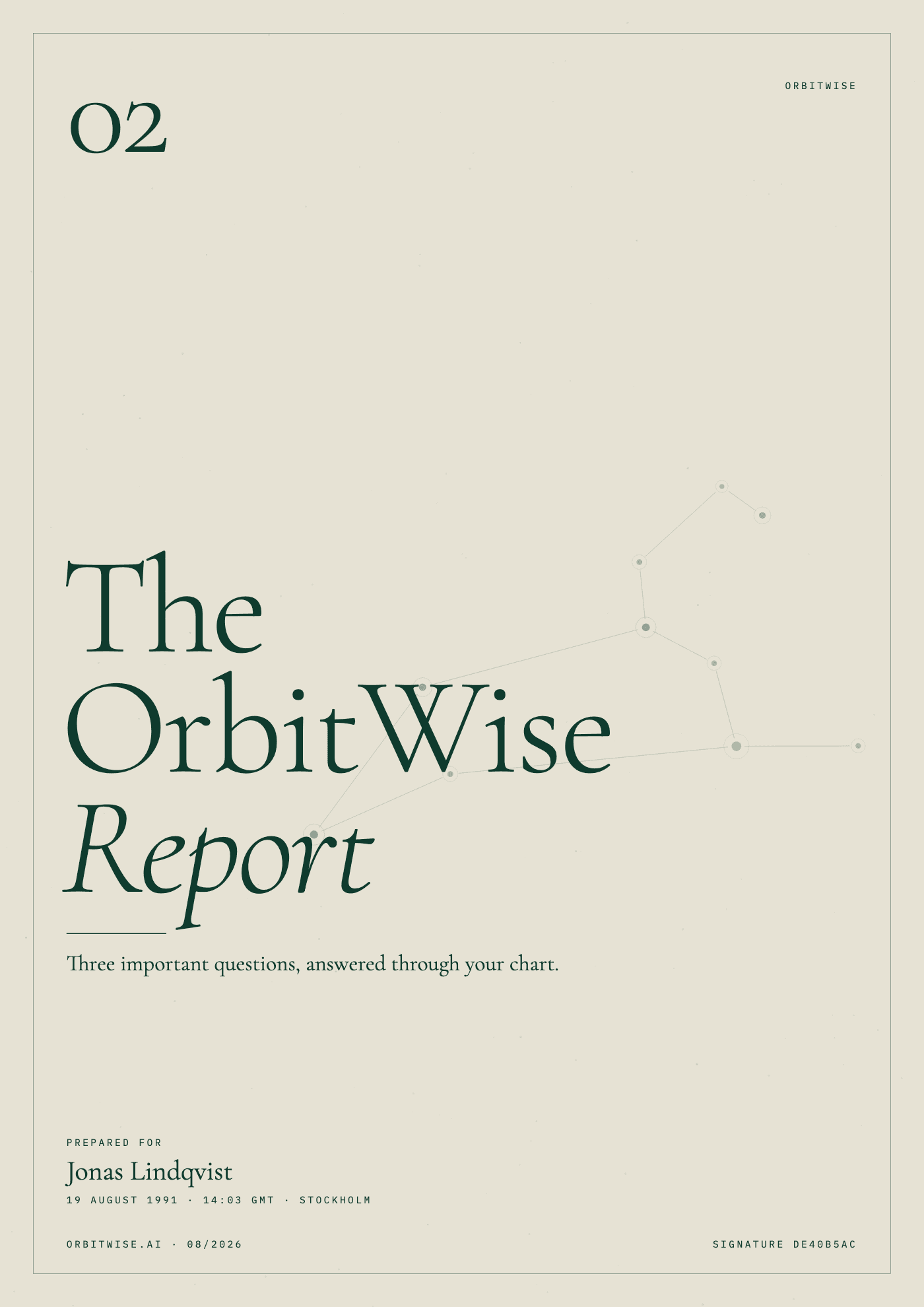
The artefact
The OrbitWise Report
- Three questions chosen by you
- Personal answers grounded in your chart
Bring the question: “What do I protect first, and how long does this weather last?”
No account needed to buy · delivered within 48 hours.