Public Visibility & Reputation Management
“When should I step forward, and in what form?”
There are windows when being seen compounds and windows when it exposes. The OrbitWise Report names yours for the quarter, with dates, and tells you what kind of visibility the season supports.
Nobody tells you the appearance went badly. They just do not come back.
The interview you asked for, the application, the work put in front of the people who decide, the first shift back after five years out. You finished it, so you put it out, and the week you put it out was simply the week you were ready. What came back was polite and thin. Nobody named the timing, because nobody receiving it was tracking that either. They just did not pass it on.
That quiet gets read as a verdict on the work, so the next attempt is smaller and later. Meanwhile the version of you the room met is the version it keeps. People carry forward the last thing they saw you do, and replacing an impression costs far more than making one did. Next time you are not starting from nothing. You are starting from that.
Appearing often builds a habit. Being received is decided elsewhere, on another schedule.
Most people build a name by volume: appear often, appear consistently, let it compound. That works on the half of the problem you control, which is genuinely the half most people neglect. What it cannot tell you is which of those appearances will be received, because it treats the audience as a fixed surface that answers the same in March as it does in October. It does not. Attention moves, and it moves on a schedule with no relation to the week you happen to be ready.
Read against a specific ninety days, a chart names when an audience is assembled and when it has already answered. That is a claim about reception rather than readiness, and the two are not the same measurement. The quarter is graded against itself, peak, strong and steady, and three windows inside it are dated, each with a paragraph on what it favours and what it is worth spending on. The difference it names is placement, not volume.
An appearance that lands flat is not a neutral event. It leaves a reading of you behind, and the second attempt has to clear that reading before it can do anything else. Going out in a window that does not favour it costs you the one that does, because by the time the better weeks arrive the people you needed have already formed a view.
A quarter runs ninety days, and only a few of its weeks have anyone listening.
The report answers five fixed sections for every reader, three sentences each: career, deals, team, relationship, geography. They do not carry equal exposure in any given quarter. One of them is where you will be looked at hardest across these ninety days, and it is rarely the one you have been preparing for.
The quarter is graded against itself in three bands, peak, strong and steady, and three windows are dated inside it, each with a paragraph on what it favours and what it is worth spending on. A talk, an application, a first shift back or a piece of work you have been sitting on can then be booked into a dated week rather than into the next free one in the diary.
Drawn from your real chart in The OrbitWise Report, delivered within 48 hours.
Ask my three questionsThe questions that decide how an appearance lands.
The question people bring is whether the work is good enough yet. These six are what the read puts back to them instead.
The appearance you did not schedule
Half of being seen is not chosen by you. You get put forward, nominated, copied in, asked to cover for someone at four days' notice. That appearance lands in whatever week it lands in, and refusing it has a cost of its own. The question is not whether you are ready to be seen. It is what you do with a showing you did not get to date.
Visible to many, or visible to eight
The same ninety days can be closed to a wide audience and wide open to eight people who already know your name. Effort spent on the crowd in one of those returns less than a single conversation would have. Knowing which one this quarter is in lets an appearance be scaled down rather than cancelled, and scaled down is the version most people never consider.
Why second attempts underperform first ones
A flat first showing sets the terms for the next one. To clear the reading it left, the second attempt has to be larger than the first ever needed to be. People do the opposite: smaller, later, to a shorter list, because the first one taught them caution. That is the trap, and it is how a recovery attempt confirms the verdict it was meant to overturn.
Widen the audience or deepen it
Most people work on reach while their standing is settled by six or eight people who already know their name. Those are different projects and they want different quarters. One asks you to be findable by strangers. The other asks you to be re-encountered, in person, by people who have already formed a view and are not looking for a reason to revise it.
What is said about you when you are not there
Something gets said in a review, a meeting, a group chat, a room you were not in. The instinct is to correct it immediately and the instinct is often wrong, because a correction made in a week that is not carrying you repeats the charge to people who had not heard it. The question is never whether the charge is fair. It is whether this is a quarter in which your version travels further than theirs.
The bill that arrives when it works
Visibility that works sends a bill. Requests you did not ask for, scrutiny of work that used to pass unexamined, and a standard you are now held to every time you appear again. The size of the appearance decides the size of the bill. Choosing that size in advance is a different act from discovering it once the messages have started.
What the quarter hands you, dated.
Three protected windows, dated to the day
Three windows inside the quarter, each with a paragraph on what it favours and what it is worth spending on. Dated in advance, so an appearance can be booked into one rather than noticed once it has gone.
Your ninety days, ranked against each other
Every day of the quarter graded peak, strong or steady, measured against the rest of your own ninety rather than an absolute scale. That relative grading is what makes the quarter legible before you promise a date to anyone.
Five moves and five refusals, all dated
Five imperatives and five avoidances, each carrying a date, on a single page. For anyone managing how they are seen, the avoidances are the harder half to write for yourself and the more useful half to hold.
What these ninety days are for
Three paragraphs at the front: what this quarter is set up to reward, the friction inside it, and one date to mark. If these ninety days are not built for stepping forward, that is where it shows.
Career, deals, team, relationship, geography
Five fixed sections answered for every reader, three sentences each, against your quarter. The same five for everyone; only the answers change, which is what makes them comparable quarter to quarter.
Your city, scored
Geography gets a page of its own: your current city scored, and an alternative named only where the chart genuinely supports one. Where you are known is a fact about where you are.
The OrbitWise Report is cast for one ninety-day quarter and regenerated in full each quarter, against fresh answers and an updated chart. It is never a re-skin of the previous edition.
The appearance ends. What the room now thinks of you does not.
The report answers the question you arrived with: which weeks of this quarter favour stepping forward, and what those weeks are worth spending on. Underneath the answer sits a record that outlasts it. Your chart resolved and verified, the three windows and the reasoning that dated them, and your own account of what you are trying to be known for.
An astrologer picks it up from there, with all of that already in front of them. You are put forward for a post three weeks out, in a week your report never named: ask whether to take it or offer the later date, and the answer comes back against your own dated quarter and everything you have added since. If the question turns on what your contract lets you say in public, that one goes to a solicitor.
What your reading learns about you is kept. The next thing you read starts from everything the last one knew.
Aster runs on a monthly plan. The deeper readings include a run of free days with him, and the credits the plan gives you each month go toward your next Report. Subscriptions are not open right now. See what Aster costs.
Our position.
Free will and personal choices matter most. Whether the work is worth showing, whether you stand up and say it, whether people believe you when you do: all of that is settled by you and by the people in front of you, and none of it is settled here. Nothing in this read does an hour of that work.
The read cannot see the work. It does not know whether the portfolio is any good, whether what you want to be known for is worth being known for, or whether you can hold an audience once you have one. A thin piece put out in the strongest window of the quarter is still thin, and a window that favours it can carry thin work further than it deserves to travel, which is expensive in its own way.
And it is one instrument among several. Keep the person who tells you the draft is not finished, the mentor who says the audience is smaller than you think, the recruiter or communications person who knows how you read on paper, and an employment lawyer if what is being said about you touches your job. Each of them improves what goes out. None of them dates the week the room is turned your way.
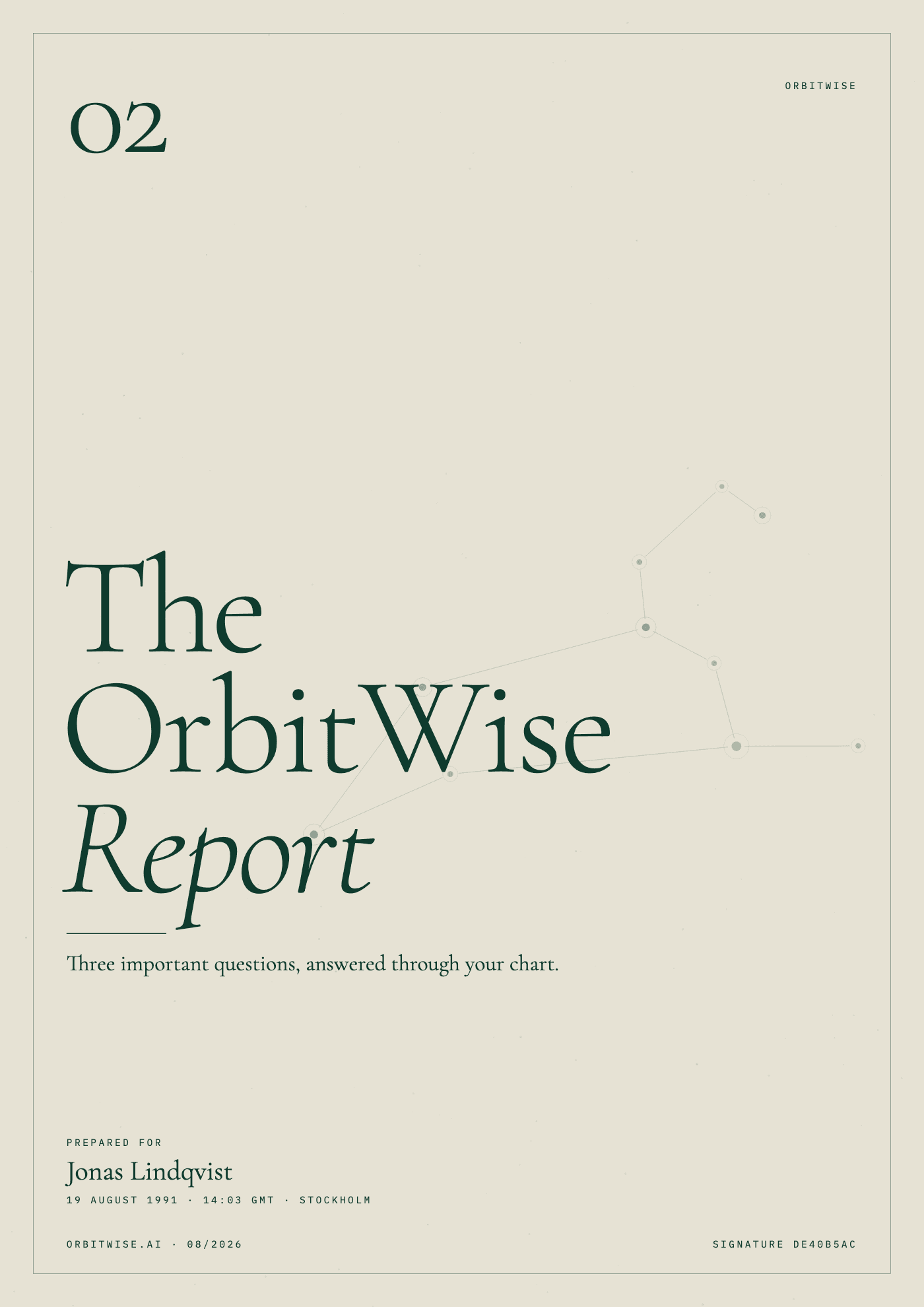
The artefact
The OrbitWise Report
- Three questions chosen by you
- Personal answers grounded in your chart
Bring the question: “When should I step forward, and in what form?”
No account needed to buy · delivered within 48 hours.