Discovering Your True Vocation
“What work am I actually built for?”
The work you are built for is usually visible in the chart long before it is visible in the CV. A full structural read names the pattern: what you build through, what drains you, and which kind of work compounds for you.
Nothing you have done has been wrong, and none of it has quite fitted.
You are competent. The work gets done, the reviews say so, and people come to you when something matters. And every role you have held arrived because it was open, or because somebody suggested it, or because the last one stopped. None of it was chosen against a description of what you are good at, because you have never had one. You have a CV instead, which is a record of what happened to be available.
So the correction gets made by trial. You take the promotion into managing people and find out at eighteen months. You retrain, sit the course, take the pay cut, then meet the same thing in the new field that emptied you in the old one. Each attempt costs three years and a piece of what you had saved. Nobody files them as failures, which is exactly why the pattern keeps running: every one of them looked like a reasonable move at the time.
A careers test can only see the jobs you have already been near.
A careers test hands you an inventory, a strengths list and a question about what you would do for free, then sends you out to three people in the field. Every input into it arrives from one place: you, describing yourself, in the vocabulary of the work you have already stood close to. Somebody who has spent fifteen years in one sector will name roles from that sector, and what comes back maps where they have been rather than how they are built.
Underneath the job titles there is a shape, and it was there before the first payslip: a set of conditions your work goes well under rather than an occupation, covering whether you build alone or in a room, whether you need a long horizon or a short one, whether pressure sharpens you or flattens you, whether you produce most when you are trusted or when you are pushed. A chart reads that layer from your birth data rather than from the list of jobs you have already seen, which is why it does not inherit the limits of your exposure.
The turn that follows is rarely a change of occupation. It is more often the same trade run for yourself instead of for a firm, the same teaching done with fourteen people rather than two hundred, the same clinical skill moved off nights. The Shift, the opening read of the foundation, is where that gets named: what your work has been circling across everything you have done, and how much of the trouble was the job rather than the fit.
Most people retrain out of a field when what failed them was the terms.
Every job you have held asked for some of this and paid for less of it. The foundation opens on the Soul Blueprint, where this ordering is set out: the ways your work goes well, strongest first, so the next move is measured against the top of that list rather than against whatever job description came round. It is ordered off the chart cast from your own birth details.
Knowing what you are built for settles nothing about when to test it. The twelve months ahead arrive as major transitions, a quarterly strip and four quarterly deep dives: which months favour asking for the part of the job you are best at, which favour the quiet build while the current wage still covers it, and which favour leaving the arrangement alone. All of it dated.
Drawn from your real chart in OrbitWise Definitive, delivered within 5 days.
Get the DefinitiveThe questions a careers conversation never reaches.
The question arrives as what should I do instead. These six are about what you have been doing all along, and none of them needs a new job title to answer.
The part of the job you were good at
No role is one thing. It is nine tasks bundled under a title, and you were carried by two of them and drained by three. When you left, you moved the title, because the title is the unit the market advertises. The bundle came with it. The move worth making is at the level of the task, and it is often available inside the job you already hold.
How long you need before anything shows
Some people are built to finish something every week and go flat without it. Others need eighteen months before there is anything to point at, and look slow for the first twelve. Put either on the wrong cycle and it gets read as a fault in the person: impatience, or an inability to ship. That reading is about character. The variable is a horizon, and a horizon can be matched instead of corrected.
Whether you are paid for output or for the seat
These are two different working lives and the money is the smaller difference. One pays for what was produced and stops when you stop. The other pays for a position held, absorbs the bad month, and asks you to be present rather than productive. People built for the first spend decades resenting the second and call it the wrong industry, when the mismatch was in how the work is paid for.
Whether the unpaid part is the actual product
There is a piece of work you do most weeks that appears in no job description and is charged for nowhere. The usual reading is that it is a temperament, a helpful streak, the price of being decent. The other reading is that it is the product and the rest of the role is the packaging it arrives in. Those two lead to different working lives, and which one it is can be read structurally rather than guessed at.
One track, or three at once
Some people run a single track for thirty years and get better at it the whole time. Others carry three and go dull inside one. The second kind spend years being told they are scattered and trying to correct it. The cost nobody names is that three tracks each held at an amateur's level get paid as three amateurs. A working life that holds several has to be built deliberately rather than drifted into.
What your leaving pattern already said
You have left jobs before. Look at what you were doing in the six weeks before you started looking, at which month it happened in, and at what you told people at the time against what was true. The pattern usually holds across sectors, which means the sector was never the thing that moved. That is data you already own and have never read as data.
The pages this question lands on.
The Soul Blueprint
Part I reads the person under the job titles: what you build through, what it costs you to do it, and the terms your work needs. It is written about the person rather than about a job title, which is what makes it usable on the job you already hold.
The Shift
The opening read of Part I: what has changed, and what your work has been circling across everything you have done. It sits at the front of the foundation, before the pages that build on it.
The rest of Part I
A one-page chart signature plate, and the five Mirrors on leadership, decision-making, conflict, romance and money. The money and decision Mirrors are the two that bear on what you will accept an offer over, and what you will turn one down for.
Where this sits in the arc
Part II: a hundred-year view of your periods, a deep read of the major period you are in now, and the whole arc sorted into three chapters. Whether these years are for consolidating a trade or changing it is answered here rather than by your age.
The present, then the twelve months
Where you stand now read at four layers, a thirty-day outlook and the week ahead. Then the year's major transitions, a quarterly strip and four quarterly deep dives, each quarter read on its own terms rather than as a twelfth of the year.
Weighted to what you came in with
The executive summary leads on the priority you named at intake, with the secondary ones behind it and a quick-wins page. The alignment part carries strategic architecture, health vigilance, the full gemstone prescription, a city scorecard, numerology, warnings and a closing letter.
Forty-one to forty-seven pages from a long-form sitting, delivered within five days. The executive summary and the quick wins are readable in fifteen minutes; the rest is built to be studied. Cast once: there is no annual re-cast by design, and anyone who wants each quarter read as it arrives is invited into the quarterly rhythm of the OrbitWise Report instead.
The fit question is answered within five days and reopened at every turn.
The question gets answered in writing: what your work needs to go well, what it has been circling across every job you have held, and which chapter of the arc these years belong to. The document is one output. The larger one is the material underneath it, holding your chart and everything you set down at the long-form sitting about the work you have actually done.
That material is what an astrologer works from afterwards, and the fit question does not get asked once. A year on, an offer arrives that pays more and puts you back in a room full of people all day. Ask whether it gives you more of what the read named or less, and the answer is worked against what is on file. On whether the pay change is survivable it names an accountant.
What your reading learns about you is kept. The next thing you read starts from everything the last one knew.
Aster runs on a monthly plan. The deeper readings include a run of free days with him, and the credits the plan gives you each month go toward your next Report. Subscriptions are not open right now. See what Aster costs.
Our position.
Free will and personal choices matter most. Whatever you end up doing, you will have gone and done it: the application sent, the trade learned, the coursework sat at five in the morning because that was the only hour there was. Every one of those hours is yours.
Fit is not a forecast. The read names the conditions your work goes well under, and it cannot see what settles most careers anyway: whether the firm is hiring, whether the sector contracts next year, whether the person across the table takes to you in the first two minutes. Any of those decides a job. None is in a chart. What it holds is which conditions are worth holding out for while all of that goes on.
And it is one instrument among several. A recruiter knows what is open and what it pays. A coach will make you rehearse the interview until it stops being a performance. Somebody already doing the job will tell you what an ordinary week of it costs. An employment lawyer reads the contract before you sign it. Every one of them works with the market as it is. None of them is looking at the shape you brought to it.
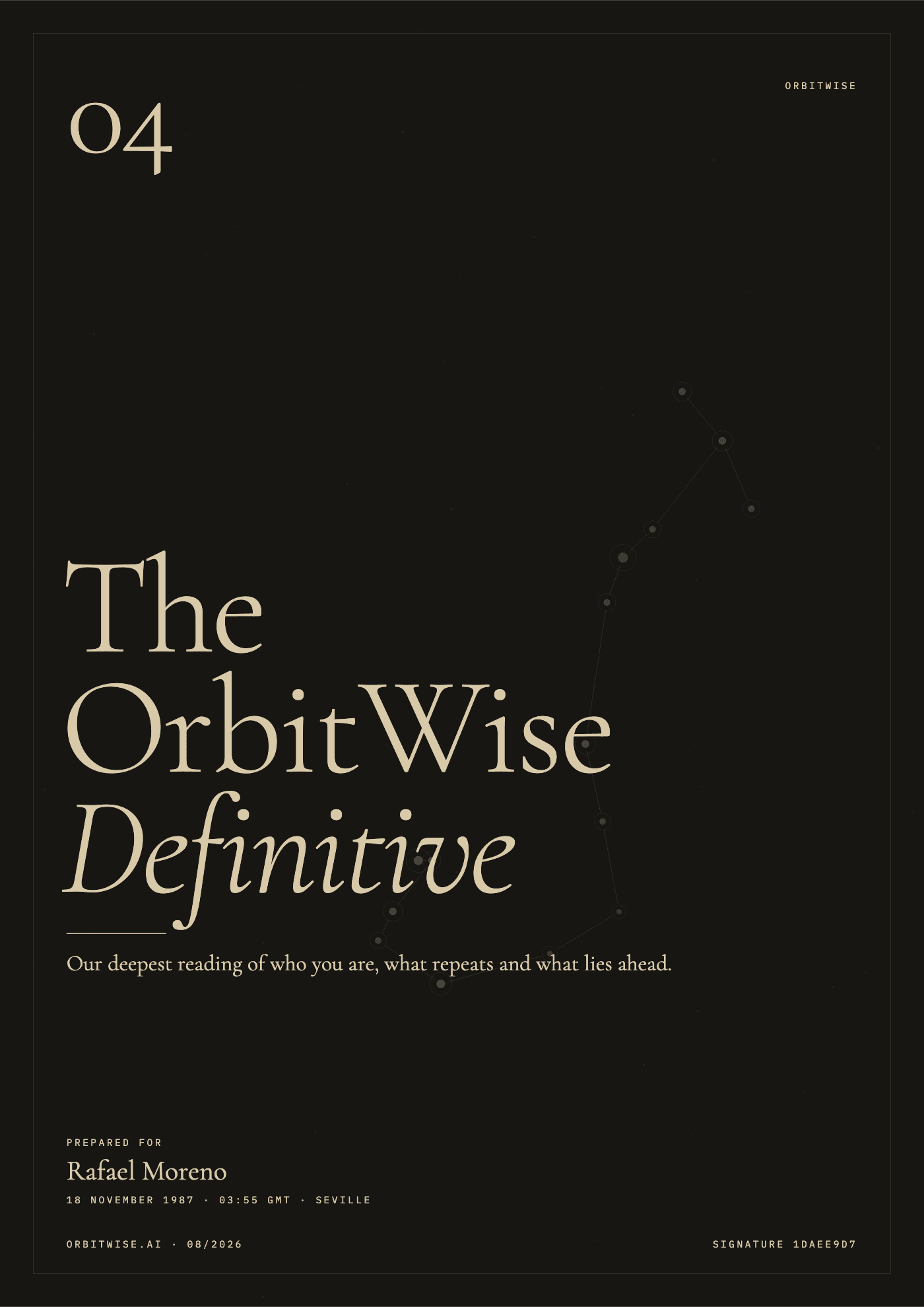
The artefact
OrbitWise Definitive
- Your major life periods
- The next twelve months in depth
Bring the question: “What work am I actually built for?”
No account needed to buy · delivered within 5 days.