Global Networking & Community Hotspots
“Where do my people already gather?”
Rooms matter, and cities are rooms. The city read scores where your kind of people concentrate for you: the geographies where doors open on the second meeting instead of the tenth.
You did the work. You still get introduced to the same twelve people.
You go to the events. You buy the coffees, you follow up, you are not bad at any of it. And the introductions keep looping back through the same dozen people, who all know each other already, so the second name you are passed to has heard about you from the first. The circle is not hostile. It is closed, and you have spent years treating a closed circle as a network that needs more effort.
The cost arrives as a story about you. You decide you are bad at rooms, or too late, or the wrong sort of person, and you stop going. Meanwhile someone no more capable moves for unrelated reasons and inside a year has three people who open doors on a first email. Nothing changed about them. The room changed. You spend the following decade working harder inside a geography that was never going to introduce you to anyone new.
Go to more events aims at your calendar. The problem is your map.
Network harder, give before you ask, show up consistently for two years. All of that is technique, and technique is not the thing failing. You already show up. You already follow up. Doing more of something that returns the same twelve names returns twelve names faster. The advice assumes every room is equally available to you and that the only variable is how well you work it, and that assumption is the one nobody tests.
Cities are not neutral ground you carry yourself into. A place either puts you in front of people who can use you or it does not, and that is not a matter of population or industry. Two people with the same trade and the same manner land in the same city, and one is inside a working circle within four months while the other spends three years being pleasant to people who never pass a name along. The difference sits in placement, and placement is readable.
A whole-life read scores geographies against your own chart rather than against a list of good cities, and it names how you meet people at all: who a room actually meets, what you do with an introduction once you hold it, and the kind of person who reliably repeats your name. Then it dates the twelve months ahead, so the trip, the move or the season of putting yourself about lands in a passage that favours introductions rather than one that favours keeping your head down.
A closed circle worked harder is still a closed circle, and you will call that a personal failing.
Introductions are not made to all of you. A room meets one part first and decides on that. The read's five mirrors, on leadership, decision-making, conflict, romance and money, describe who you are in each, so you know what a stranger is responding to and which rooms that part of you travels well in. Drawn from your chart, not from how you would describe yourself.
Introductions do not arrive evenly across a year. The twelve months ahead come as major transitions, a dated quarterly strip and four quarterly deep dives, marking the passages that favour going where the people are and the ones that favour working the relationships you already hold. The trip, the move and the conference season get placed against dates rather than against whoever invited you.
Drawn from your real chart in OrbitWise Definitive, delivered within 5 days.
Get the DefinitiveWhat a place decides about you before you have said anything.
Every one of these gets settled by where you happen to live, whether or not you ever put the question. Notice too what your current city already does for you, because what a place does well stays invisible until you leave it.
Whether you land on the first meeting or the fourth
Some people are read correctly in ten minutes and remembered for a week. Others are overlooked for two seasons and then trusted permanently. This is disposition, not confidence, and it decides which geographies work. If you land late, a city that turns its rooms over every quarter will never hold you long enough to be seen. If you land early, a slow closed city wastes the thing you are best at.
The type of person who passes your name on
Introductions do not come from everyone equally. Most people have one kind of connector who reliably repeats their name in a room they are not in: the senior person who collects people, the peer who runs the group chat, the ex-colleague who moved on and stayed loyal. Knowing which one works for you changes who you spend an evening with, and it changes which cities hold enough of them.
A large network and a load-bearing one are different objects
You can know four hundred people and have nobody who would put their own standing behind you in a room. The count grows through attendance. The load-bearing part grows through a narrower thing: repeated contact with people who watch you do the work. Cities differ enormously in whether they let that happen, and the difference never shows up in the size of the scene.
Whether the place that made you can make your next thing
The city that gave you your first proper job gave you a specific version of yourself, and everyone there still holds it. That is useful until you want to be something adjacent, at which point the accumulated context works against you. The people who know you best are the ones least able to hear a new claim. Staying is sometimes the thing that makes a second act impossible.
What is left of you when nobody has history with you
A move strips the part of your standing that came from years rather than from you. For some that is a loss of about eighteen months and a gain afterwards. For others it removes the only thing that was working. Which one you are is not a matter of nerve, and finding out by moving is an expensive way to learn it.
The rooms you skip, and what that actually costs
Everyone has formats they quietly avoid: the large mixer, the dinner of eight, the industry panel, the small hostile committee. You call it preference. Often it is accurate and the room genuinely does not suit how you meet people. Occasionally it is the one format where your kind of introduction happens, and avoiding it removes the channel rather than the discomfort.
The pages where geography stops being a guess.
A city scorecard
Part of the alignment section: geographies scored against your chart rather than against a general list of good cities, so the move, the posting and the long trip get weighed on your own placements.
The five mirrors
Leadership, decision-making, conflict, romantic and money, each written against what you reported at intake. These describe who a room meets, what you do with an introduction once you hold it, and how you conduct yourself when a new circle tests you.
Twelve months, quarter by quarter
The year's major transitions, a dated quarterly strip and four quarterly deep dives. Travel, relocation and the season you put yourself in front of people get placed against specific passages rather than against whoever is running an event.
A summary weighted to what you name
The front matter opens on the priority you name at intake. If placement and the people around you is the governing question, it leads the executive summary, secondary priorities follow it, and a quick-wins page closes the front matter.
Where this sits in a whole life
A hundred-year period view, a deep dive on your current major period, and your life sorted into three chapters with the joins named. This is the layer that separates a city that stopped working from a chapter that did.
The near ground, and the close
The four layers of the present, a thirty-day outlook and the week ahead, then strategic architecture, health vigilance, the full Gemstone Crown, numerology alignment, a warnings page and a closing letter.
The Definitive runs forty-one to forty-seven pages, delivered within five days of a long-form sitting. It is a whole-life foundation carrying a twelve-month forward horizon, cast once with no annual re-cast: owners are invited into the quarterly rhythm of the OrbitWise Report instead.
A scorecard names the cities. Living in one is the part that takes years.
The read answers where your people concentrate and what a room meets in you, and it fixes a record doing it. Your chart, resolved once. The long-form sitting where you described the circle you have and the one you cannot reach. The city scorecard, written before you had booked anything.
Eight months on, you have an invitation to two weeks of meetings in a city the scorecard rated well, and a quieter option at home. Put that to an astrologer that already holds the sitting, the scorecard and every introduction you have reported since. A new subscriber holds none of it. On the visa or the contract it names your lawyer.
What your reading learns about you is kept. The next thing you read starts from everything the last one knew.
Aster runs on a monthly plan. The deeper readings include a run of free days with him, and the credits the plan gives you each month go toward your next Report. Subscriptions are not open right now. See what Aster costs.
Our position.
Free will and personal choices matter most. Whether you move, who you write to, whether you go to the thing on a wet evening when you would rather stay in: those are yours, and this document has no vote in any of them. A city can be full of your people and stay shut if nobody knocks.
This describes ground, not outcome. It cannot see whether the person who would have introduced you has already left that city, what the visa rules will be in eighteen months, or whether the group you are trying to reach is about to come apart over something private. What it gives is which geographies concentrate your kind of people, and when the year favours going to them.
And it is one instrument among several. An immigration lawyer for whether you can lawfully live there, an accountant for what a change of residence does to your tax position, a recruiter or an industry association for who is genuinely hiring and gathering in a given place. This read sits beside them and answers a narrower question: where your kind of people concentrate, and when to be among them.
The artefact
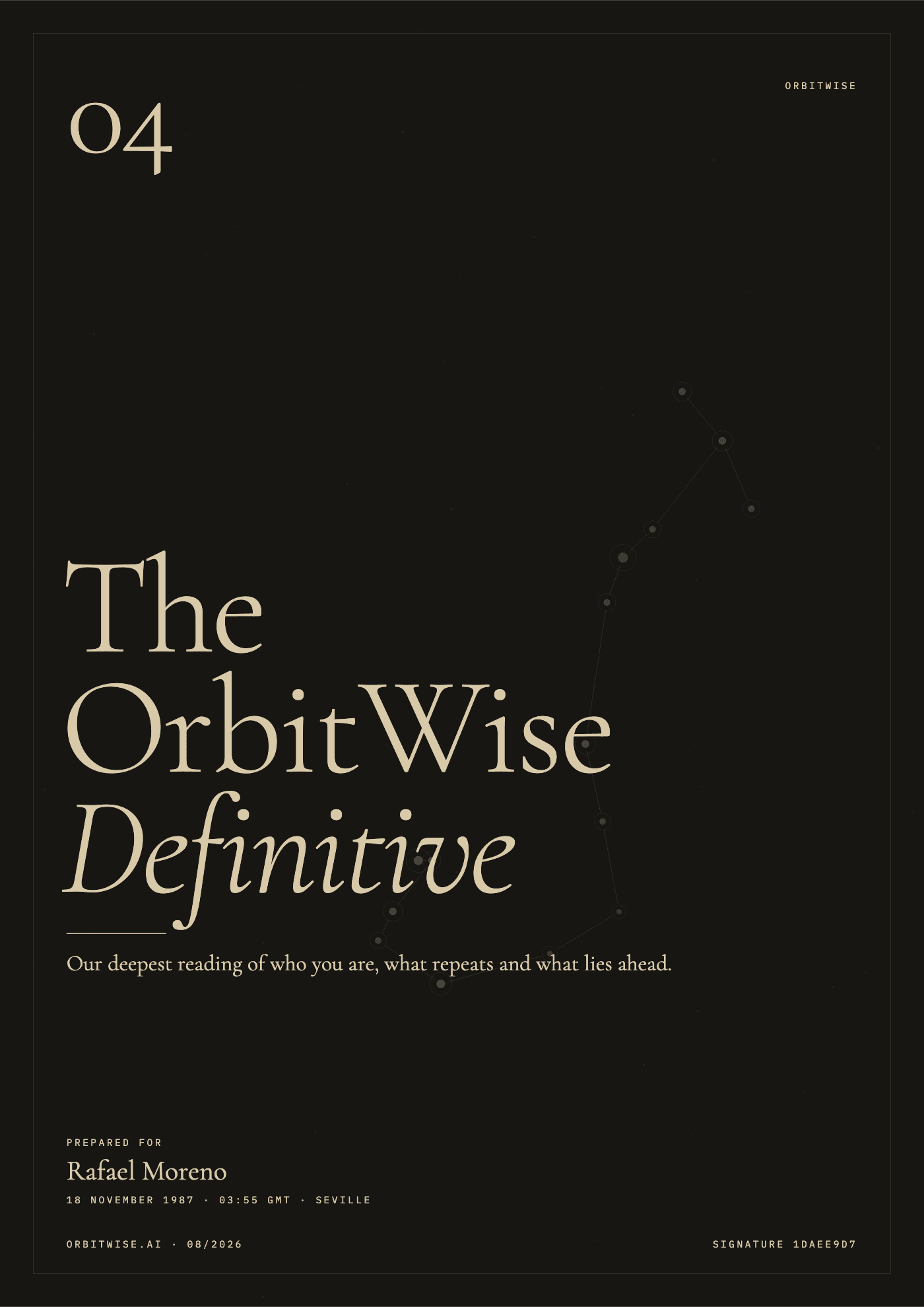
OrbitWise Definitive
- Your major life periods
- The next twelve months in depth
Bring the question: “Where do my people already gather?”
No account needed to buy · delivered within 5 days.