Global Hotspots for Wealth & Investment
“Where does my money work hardest?”
The city scorecard reads your money pattern against place: where your earning channels open, where costs quietly eat the gains.
Most people never choose where their money sits. They inherit it from where they landed.
You have a salary in one country, savings in another, and a policy or a pension in a third you have not logged into since you left. None of that was chosen. It accumulated, one job and one move at a time, and what you are holding now is the residue of four practical decisions nobody has gone back and reviewed. It works, in the narrow sense that nothing in it has broken yet.
The cost never arrives as a loss. It arrives as a thin margin taken quietly for years: the currency converted in the wrong direction twice a year, the fees on a monthly transfer you stopped reading, the flat across a border a relative manages for free and badly, the tax paid in two places because nobody worked out which one you belong to. Nothing fails. It simply returns less than it should, everywhere, at once.
Geography stopped mattering to the money. It never stopped mattering to the holder.
Money is borderless now, the argument runs. Open an account from your phone, buy an index that owns the whole world, hold it in whichever currency is convenient, and the map goes flat. As a claim about instruments it survives scrutiny. Capital does move, and a fund does not care which airport you flew out of. What it answers is where money can go. It says nothing about where you can hold it from, and the holding is the whole of the job.
You are not portable in the way the money is. Your earning sits inside a network of people who can physically reach you. Your costs sit in a place with a rent, a school run, a tax residency and a family you fly back to. Move the capital anywhere you like: what you can actually put behind it is set by where you are standing when the payment lands. Two people running the identical position from two cities finish in different places, and neither of them picked the wrong fund.
A chart read reverses the order of the question. Instead of asking which market to be in, it scores the place you are holding from against what your own data asks of a place: whether it opens earning channels or only expenses, whether it favours accumulation or steady drain, whether standing built here travels when you leave. Part V of the report does that on named cities. The twelve months say which stretches favour moving a holding and which favour leaving it exactly where it is.
Two people hold the same asset in two cities, and only one is being paid for it.
Part V gives a page to location: a city scorecard reading named cities against what your chart asks of a place. What is ranked here is what a location either does for money or does not, before a market, a tax rate or an asking price enters it. The order comes out of your own birth data rather than out of what the league tables say about the city.
A holding does not get reviewed on the day it occurs to you. The report lays the twelve months ahead out as major transitions, a quarterly strip and four quarterly deep dives, separating the stretches that favour moving money across a border from the ones that favour leaving a position still and letting it sit. Every stretch it names arrives dated.
Drawn from your real chart in OrbitWise Definitive, delivered within 5 days.
Get the DefinitiveWhat nobody asks before opening an account in another country.
Where to invest is a question about markets, and every bank has an answer ready before you sit down. These six are about the person doing the holding and the place they are holding from.
Which city is actually paying you
Your income has an address, and it is rarely the one printed on the account. Trace the last three things that paid you properly: who introduced them, where that person was standing, and which room you were in. If all three run back to one city and you live in another, you are operating a channel remotely and paying for that in both directions.
The cost that never appears on a statement
The drag on a cross-border holding is never the headline fee. It is the currency converted twice, the account kept open for one direct debit, the two accountants who each assume the other handles the awkward part, and the six weeks a year you spend administering the arrangement. None of it appears as a loss. All of it comes out of the return.
Diversified, or simply scattered
Holdings in four countries look like diversification and are frequently the opposite: four positions too small to matter, each carrying its own paperwork, and not one you could put real weight behind. The test takes a minute. If any single one of them tripled, would anything change. If the answer is no every time, that is not a portfolio, it is a set of souvenirs from previous moves.
What each pot is actually for
Money held to be spent, money held to be safe and money held to be grown want three different places, and most people run all three out of one arrangement. Safety wants somewhere dull and reachable. Growth wants somewhere you can leave alone for a decade. The spending pot wants to be near you. Ask which of the three each account is doing, and at least one will have no answer.
Whether the country you left still earns its keep
The property, the account and the policy you kept in the country you left were correct decisions for the person who made them, and that person had different plans. Nobody reopens them, because reopening them means admitting the return may not come. The question is not whether you are going back. It is whether the holding earns its keep on today's facts alone.
Why the good year happened where it happened
Look at the two or three years your money genuinely moved. Something was true about the place as well as the market: you were reachable, your costs were low against what came in, and the people who mattered were within an hour of you. Most of us credit the year to the decision and repeat the decision somewhere else. The conditions were half of it, and conditions have a location.
What the Definitive puts on the page about place.
A page given to where you are
Part V gives a page to location: named cities scored against your chart, with what each one opens and what each one takes. It sits beside the strategic architecture rather than instead of it, so the place question is answered next to the money question.
The money mirror, among five
The foundation runs five mirrors: leadership, decision-making, conflict, romantic and money. The money mirror is where your own pattern with holding, spending and risk is written down in a form you can hold against the last decade of statements.
Front matter that opens where you did
The executive summary is weighted to the priority you name at intake. If where the money sits is the dominant question, it takes lead position, the secondary priorities follow it, and the front matter closes on a quick wins page.
Twelve months, read four times
The year ahead arrives as major transitions, a quarterly strip and four quarterly deep dives. The quarters that favour moving a holding across a border are separated from the ones that favour leaving it where it is, with dates.
Where the holding sits in the arc
A hundred-year view of your periods, a deep read of the major period you occupy now, and the life sorted into three chapters. This is where a stretch built for accumulating separates from one built for consolidating, which decides how a holding should be shaped.
Alignment, and what to watch
Strategic architecture weighted to the priority you named, the full Gemstone Crown, numerology alignment against your legal name, health vigilance, a warnings section, and a closing letter.
The Definitive is a one-time casting on a whole-life foundation: forty-one to forty-seven pages, a twelve-month forward horizon, delivered within five days. It is not re-cast annually.
A holding is a decision you keep making, in a currency that keeps moving.
The report answers where your money should sit and why. Getting there means a record exists that did not before: your chart resolved from real birth data, what you said at the sitting about the accounts, the property and the country you left, twelve months graded against each other, and the reasoning kept beside every city it scored.
Afterwards an astrologer answers live questions against that record. Your bank in the country you left writes to say the account closes unless you move or convert it, and gives you a month. Ask whether these weeks favour bringing the holding within reach or parking it somewhere neutral until a better stretch opens. Whether the tax works belongs to your accountant, and it says so.
What your reading learns about you is kept. The next thing you read starts from everything the last one knew.
Aster runs on a monthly plan. The deeper readings include a run of free days with him, and the credits the plan gives you each month go toward your next Report. Subscriptions are not open right now. See what Aster costs.
Our position.
Free will and personal choices matter most. You choose the country, you sign the transfer, you decide what risk you can sleep on and how much of your life you are willing to run across two time zones. This read moves no money and carries none of the consequence when money moves.
What it describes is ground, not a return. It reports what a place does with money in your hands: where earning opens, where costs quietly take the gains, and which stretches of the year favour moving a holding rather than sitting on it. It cannot see an exchange rate, a bank's fee schedule, a change in residency rules or what a market does next quarter. Those are facts, and facts belong to the people who track them.
And it is one instrument among several. Your accountant reads the tax in each country, a cross-border adviser reads residency and reporting, a financial planner sizes the holding against the rest of your life, a currency broker prices the transfer, and a lawyer decides how all of it passes on. Every one of them works on the arrangement you already have. None of them asks whether the place you hold it from suits you.
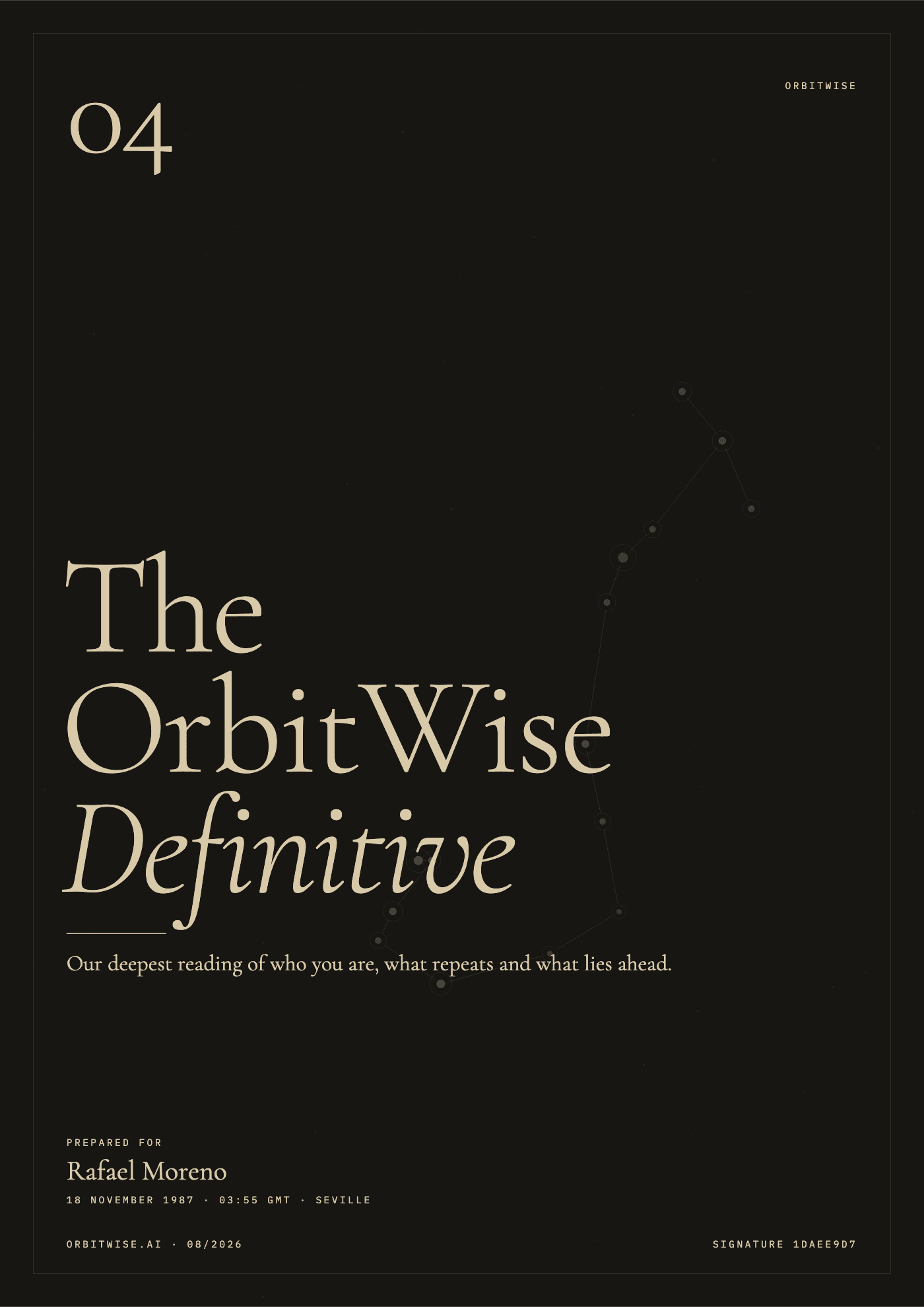
The artefact
OrbitWise Definitive
- Your major life periods
- The next twelve months in depth
Bring the question: “Where does my money work hardest?”
No account needed to buy · delivered within 5 days.