Navigating Geographies of Friction
“Is it me, or is it this city?”
Some places fight a chart. If a city keeps costing you more than it returns, the read names whether it is the place, the season, or the pattern you brought with you.
Every ordinary thing here takes one more step than it should.
The rent takes the raise. The commute takes the evening. Every piece of admin here needs three visits instead of one, and the friendships you have made in four years are still the sort you cannot ring at eleven at night. Nothing here is a disaster. It is that the ordinary business of living costs a surcharge you never agreed to, paid daily, in small amounts, and you have stopped noticing you are paying it.
The expense is not the place. It is the years spent unable to tell whether the tiredness belongs to the city or to you. So you either stay, quietly downgrading what you expect from a life, or you move and carry the same grind to a new postcode and find it waiting there. Both answers cost a decade. Almost nobody gets the third thing, which is knowing which of the two it was before acting on the guess.
Wherever you go, there you are. True of you. Not true of the place.
Two pieces of advice compete here, and both aim under the question. The first says a city is arithmetic: run rent against salary, tax against schools, commute against square metres, and the sums tell you where to live. The second says place is irrelevant, that you carry your problems in your luggage. The spreadsheet compares cities against an average person who is not you. The proverb is a polite way of telling someone their exhaustion is a character flaw.
Places are not neutral and they are not uniformly good. A chart read against a location describes how you specifically function on that ground: what a place asks of you, what it pays back, and whether the return arrives as money, as standing, as health, or as people. Two people can hold the same job in the same city on the same salary, and one of them is compounding while the other is grinding. That difference is structural, it is stable, and it is legible before another four years go into testing it.
There is a third possibility the spreadsheet cannot hold. A city that costs you now may not have cost you five years ago, because the period you are in changed what the ground does. So the read separates three things that feel identical from inside: the place, the season, and the pattern you brought with you. Acting on the wrong one is how people cross continents to solve something that was going to lift anyway.
A city, a season, and a habit all feel the same from inside a hard year.
A place does not cost you evenly. It charges in one or two departments and leaves the rest alone, and the one you complain about is seldom the one carrying it. The five mirrors, on leadership, decision-making, conflict, romance and money, describe who you become on this ground. The city scorecard rates the places themselves against your placements, not against a cost index.
Whether to go is one question. When is the other, and it is the one that decides what the going costs. The twelve months ahead arrive as major transitions, a dated quarterly strip and four quarterly deep dives, naming the passages that favour a move, a lease signed, a job taken on new ground, and the passages that favour staying put and letting the season finish.
Drawn from your real chart in OrbitWise Definitive, delivered within 5 days.
Get the DefinitiveThe questions a relocation spreadsheet has no column for.
Every one of these gets answered by staying another two years, or by moving and finding out. Notice also which departments this ground leaves entirely alone: those are the ones people give the city credit for, and they were never the city's doing.
Whether the place is costing you or the period is
A hard three years in one city gets blamed on the city, because the city is the visible thing. A period in your chart runs to its own clock and takes no notice of your postcode, and a difficult passage in a place that suits you has the same weekly texture as an easy passage somewhere wrong. The two separate on evidence: what exactly got harder, and whether it got harder everywhere at once.
What you moved here to escape, and whether it came
People move to escape a specific thing: a family, a ceiling at work, a version of themselves the old place kept insisting on. The pattern that produced it is structural and travels at full strength. Geography does not decide whether it turns up. It decides how expensive it is when it does, and which department it presents in. Naming it once is what stops the next move being the third attempt at the same escape.
Which department a place is quietly subsidising
The grind is loud and the return is silent. A city that has cost you money for six years may have been holding your health, or the two friendships you would not now replace, or a standing at work that took all six years to build. People count the surcharge and never the subsidy, then leave and find out what was being paid on their behalf. That list is short, and worth reading before the notice is drafted.
A different city, or a different life in this one
Most people put the whole question on geography because geography is the lever that moves in one weekend. The read separates the ground from the arrangement standing on it. A place can be right for you and the job on it wrong, the flat wrong, the hours wrong, and every one of those is cheaper to change than a country. Moving is the most expensive experiment available and it is usually run first.
The version of you a place brings forward
You are not the same person in two cities, and the difference is not mood. One ground brings out the operator who decides quickly and is slightly harder to live with. Another brings out the one who is generous, slower, and easier to take advantage of. Both are yours. The question is which one the next ten years need, because the ground you stand on decides which of them shows up for them.
Why the answer keeps changing every March
Ask yourself whether to leave in a good month and you will stay. Ask in a bad one and you will have a flat viewed by Sunday. The verdict tracks the week you asked it in, which is why the question has stayed open for years without resolving.
The sections that carry the geography question.
A city scorecard
Part of the alignment section. The places in question rated against your own placements rather than against a cost index, so a shortlist stops being a debate about rent and becomes a comparison you can act on.
The five mirrors
Leadership, decision-making, conflict, romantic and money, each read against what you reported at intake. This is where the version of you a place brings forward gets described, department by department.
Twelve months, quarter by quarter
The year's major transitions, a dated quarterly strip and four quarterly deep dives. Leases, notice periods and the move itself get placed against specific passages rather than against whichever month you happened to ask in.
Where this season sits in a whole life
A hundred-year period view, a deep dive on the major period you are currently inside, and your life sorted into three chapters with the joins named. This is the layer that tells a hard city from a hard passage.
A summary weighted to what you name
The front matter opens on the dominant priority you give at intake. If the place is the governing question, it leads the executive summary, secondary priorities follow, and a quick-wins page closes the front matter.
The near ground, and the close
The four layers of the present, a thirty-day outlook and the week ahead, then strategic architecture, health vigilance, the full Gemstone Crown, numerology alignment, a warnings page and a closing letter.
Forty-one to forty-seven pages, produced within five days from one long-form intake. The Definitive is a whole-life foundation carrying a twelve-month horizon, cast once only, with no annual re-cast; owners move into the quarterly rhythm of the OrbitWise Report instead.
A city keeps charging you after the document is finished.
The read settles which of the three it is, and dates the year. Making it also puts something on the record: your chart resolved once, the sitting where you described this ground and what it has charged you, and the mirrors written while you were still standing on it. That record does not expire when the year it dated does.
Eighteen months on, a job comes up in another country and you have ten days to answer. Put that to an astrologer that already holds the sitting, the scorecard, and what this ground actually did to you across the year since. Ask it whether the grind you would be leaving has already started lifting. On the visa, the contract and the tax position it does not advise on substance; that is a lawyer and an accountant.
What your reading learns about you is kept. The next thing you read starts from everything the last one knew.
Aster runs on a monthly plan. The deeper readings include a run of free days with him, and the credits the plan gives you each month go toward your next Report. Subscriptions are not open right now. See what Aster costs.
Our position.
Free will and personal choices matter most. Whether you stay, whether you go, and what you build once you are there get decided by you, in a conversation with someone you love or on an afternoon with a lease in front of you. A place applies conditions. A person decides what to do on them.
What this is, is ground rather than fate. It cannot see the school places open in the district you are weighing, or whether your employer still funds that role in two years, or what your mother's health will ask of you. What it gives is how you function on given ground, what it charges, what it returns, and when across the twelve months ahead a move is favoured over staying put.
And it is one instrument among several. Run the numbers with an accountant who knows both tax positions, take the visa question to an immigration solicitor, and get a recruiter to tell you honestly what your work is worth in that market. This read sits beside them and answers the narrower question: what this ground costs you, and whether now is when to move on it.
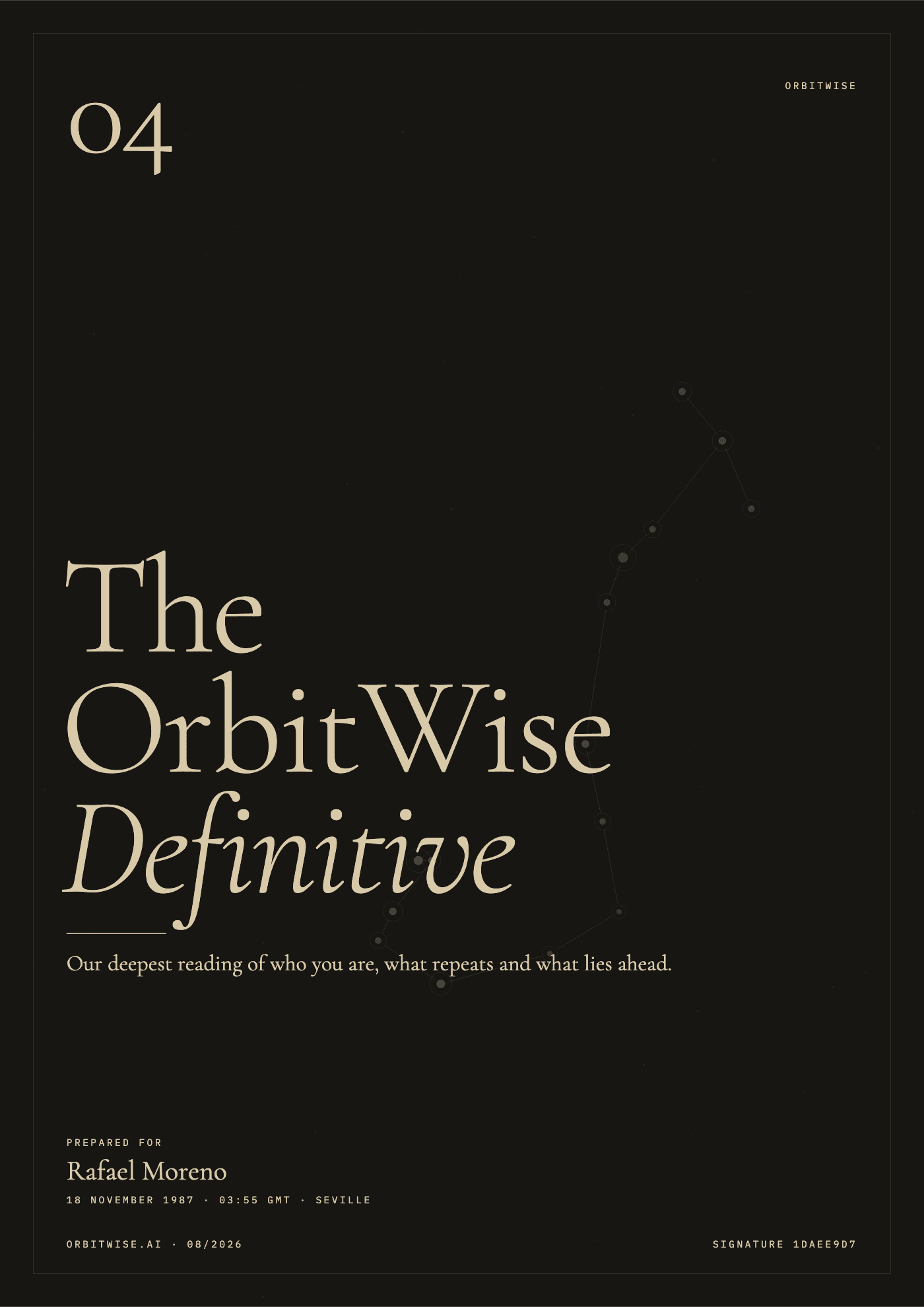
The artefact
OrbitWise Definitive
- Your major life periods
- The next twelve months in depth
Bring the question: “Is it me, or is it this city?”
No account needed to buy · delivered within 5 days.