Navigating Eclipses & Sudden Shifts
“Is this disruption a door or a detour?”
When the ground moves suddenly, bring it to the OrbitWise Report: your own questions answered against your chart within 48 hours, and the dates the turbulence opens, peaks and settles across the quarter it belongs to.
The change was made for you, and you are still expected to have a plan.
The call came on a Thursday and by Friday three people needed to know what you were going to do about it. A role dissolved, a partner left, a deal you had already spent, a diagnosis, a move you did not choose. You are being asked for a position on something you have not finished absorbing, and nobody asking is being unkind. They are just faster than you are.
Then comes the interval. Six weeks of provisional decisions taken from an unsettled position: the offer accepted early because not knowing was unbearable, the flat given up, the message sent before you had slept on it, the thing shut down that only needed leaving alone. None of them felt like decisions at the time. Most of them will still be in force a year later, long after the disruption itself has become a story you tell in two sentences.
Everyone tells you not to decide anything yet. That is also a decision.
Make no big decisions right now is what you will be told, by everyone, before anyone has looked at what actually happened. It is the right posture for only part of what has happened to you, and nobody issuing it is distinguishing which part. Every sudden shift gets the same prescription, and the prescription never reads the event. It protects your judgement in week one and tells you nothing about week three.
Two things arrive looking identical. One is an interruption inside something that has not ended: the road bends, you lose four months, and you rejoin it with the same people and the same unfinished argument. The other is a door. It opened because something structural moved, and it will not stand open indefinitely for your convenience. Treat the door as the bend, and you wait it out politely while the opening does its closing on a schedule that was never yours.
Here is the uncomfortable part: you cannot tell which one you are in from how it feels. Both arrive as loss, both cost the same night of not sleeping, and the door often feels worse, because a real opening takes away something you were relying on. The event was never legible in advance. The season it landed in is another matter: eclipse dates are arithmetic, printed years ahead, and an eclipse is the marker people already have a word for. Read against your chart they say which period the weeks after belong to.
The openings people regret are the ones they were still preparing for.
A sudden change lands in one part of a life and gets felt in all of them, which is why the loudest area is rarely the one that moved. The OrbitWise Report answers the questions you write in your own words, one per page, dated and prescriptive, alongside the five it always asks, then ranks the ninety days themselves into peak, strong and steady bands. Every line of it is computed from your own birth data before any of it is written.
An eclipse has a date, and every almanac holds it years ahead. What it meets inside your own quarter is the part no almanac holds. The OrbitWise Report ranks these ninety days against each other into peak, strong and steady bands, then names two or three protected windows with specific dates. The days that will hold a decision you cannot take back are not spread evenly, and none of them announce themselves.
Drawn from your real chart in The OrbitWise Report, delivered within 48 hours.
Ask my three questionsWhat nobody asks in the week after the ground moves.
The question people bring is when it will be over. You write those questions yourself and get dated answers back, so choosing them badly is the only real way to waste this. These six are what the choice should be between.
What the shift did to your horizon
A rupture changes what every commitment made under the old arrangement is actually worth. The lease signed against a salary that has stopped. The course enrolled in for a role that no longer exists. The promise to be somewhere in March, made by somebody whose March has changed. Almost nobody reopens any of them, because they were settled questions and this month is full of open ones.
Which of the doors is the live one
A rupture opens several things at once. The old contact who resurfaces, the flat that comes free, the conversation you can finally have without cost. They are not equally live and they do not stay open for the same length of time. The read names which of the next ninety days holds an opening, so you stop treating the whole month as equally available and spending the good week on the weakest of them.
Your first ten days, before you run them
Under sudden change you have a default: take the first solid thing offered, go quiet and let other people decide the shape of it, or burn something so the change cannot be reversed. You will run yours whether or not you have ever looked at it, and a fortnight is long enough to make it permanent. Named in advance it stops being a reflex and becomes a position you can choose to hold or override.
The decision being smuggled through
Part of your response is not about the event at all. The resignation that is actually about one person, the move that is actually about a call two years ago. A disruption grants temporary permission for things you have wanted for a long time, and that permission expires quietly. The separation worth making is which of your responses belongs to the shift and which is riding under its cover while the cover lasts.
What everyone else is timing against
A sudden shift is never only yours. An employer, a landlord, a counterparty, a family member each has a deadline attached to your silence, and they are counting from the event rather than from your readiness. The quarter has days that will take a hard sentence put to somebody and days that will only take an acknowledgement. Choosing which of the thirty you speak on is a lever most people never pick up.
Which of it was already going
A shift takes several things at once, and they were not all the same loss. Some were already leaving: the role you would have left inside a year, the arrangement nobody was renewing, the friendship that ran on proximity to a job. The event brought the departure forward and took the blame for all of it. Separating the taken from the merely early decides how much of the weeks after goes on trying to get things back.
What lands in your inbox within 48 hours.
Your first question, answered and dated
The question you actually came in with gets a full page: the answer, direct and prescriptive, with dates in it. Written to be read by someone who has never looked at a chart and has to reply to somebody this week.
Two more pages, and you choose them
Alongside the five it always asks, the OrbitWise Report answers the free-form questions you write yourself, one per page. Nothing is fixed for you: whether to take what has been offered, whether to say it now, whether to undo the thing you did in week one.
The ninety days, ranked against each other
Your coming month banded into peak, strong and steady. The ranking is relative, each day set against the others in your own window rather than against an absolute scale, so the shape of the month is visible before you commit anything to it.
Two or three protected windows
Dated to the day, inside the ranked ninety, for the calls that should not be made in the week the news landed. What the report will not do is name a window without naming which days it runs across.
Every date named specifically
An eclipse date is public arithmetic, and it is not a window. The report either gives you a date of your own or does not claim a window at all. Once things settle down is not a sentence OrbitWise will send you.
The closing note, and what comes next
A short close, signed OrbitWise, naming the higher tiers and what each one opens, including the ninety-day quarter the OrbitWise Report is cast for.
One casting, one ninety-day window, in your hands within 48 hours. It is built to be re-cast each quarter on the data you have already given, and when the disruption resolves into a pattern that has run for years rather than months, the Definitive is the document for that.
A sudden shift is not one decision. It is one decision and then nine more.
Your questions get answered and dated. The answers are the visible part. Behind them sit your birth data resolved into a chart, the questions you brought in the worst week of it, ninety days ranked against each other, and every protected window written down with its dates. You spend the answers inside the quarter. What sits behind them does not go with them.
Week one stays on file, so month four does not start from nothing. An astrologer works from that file. Seven weeks on, the employer who removed your role offers a consulting arrangement and gives you eleven days: ask whether that reopens the door or holds it half shut. On whether the settlement terms are fair it does not advise, and names an employment solicitor.
What your reading learns about you is kept. The next thing you read starts from everything the last one knew.

Aster runs on a monthly plan. The deeper readings include a run of free days with him, and the credits the plan gives you each month go toward your next Report. Subscriptions are not open right now. See what Aster costs.
Our position.
Free will and personal choices matter most. What happens next gets decided by people: the call you return, the offer you turn down, the sentence you say out loud to somebody who was not expecting it. Each of those is executed on your own nerve, in a week nobody else has to live through, and not one of them is taken by this read.
The limit is worth naming. An eclipse date sits in an almanac years ahead of it happening. What it did to you on a Thursday in March sits nowhere, and this read cannot see it: not the person on the other end of the call, not what the offer is actually worth. It forecasts no event. What it names is which period of your chart these weeks belong to, and which of the next ninety days will hold a decision you cannot undo.
And it is one instrument among several. Take a solicitor's read on what you have already signed, a doctor's on what the first month did to you physically, an accountant's on how long the gap can run. If the shift took a person from you, a therapist or a grief counsellor is the right room and this is not. None of them is scoped to say which of the next ninety days an opening is genuinely standing open on.
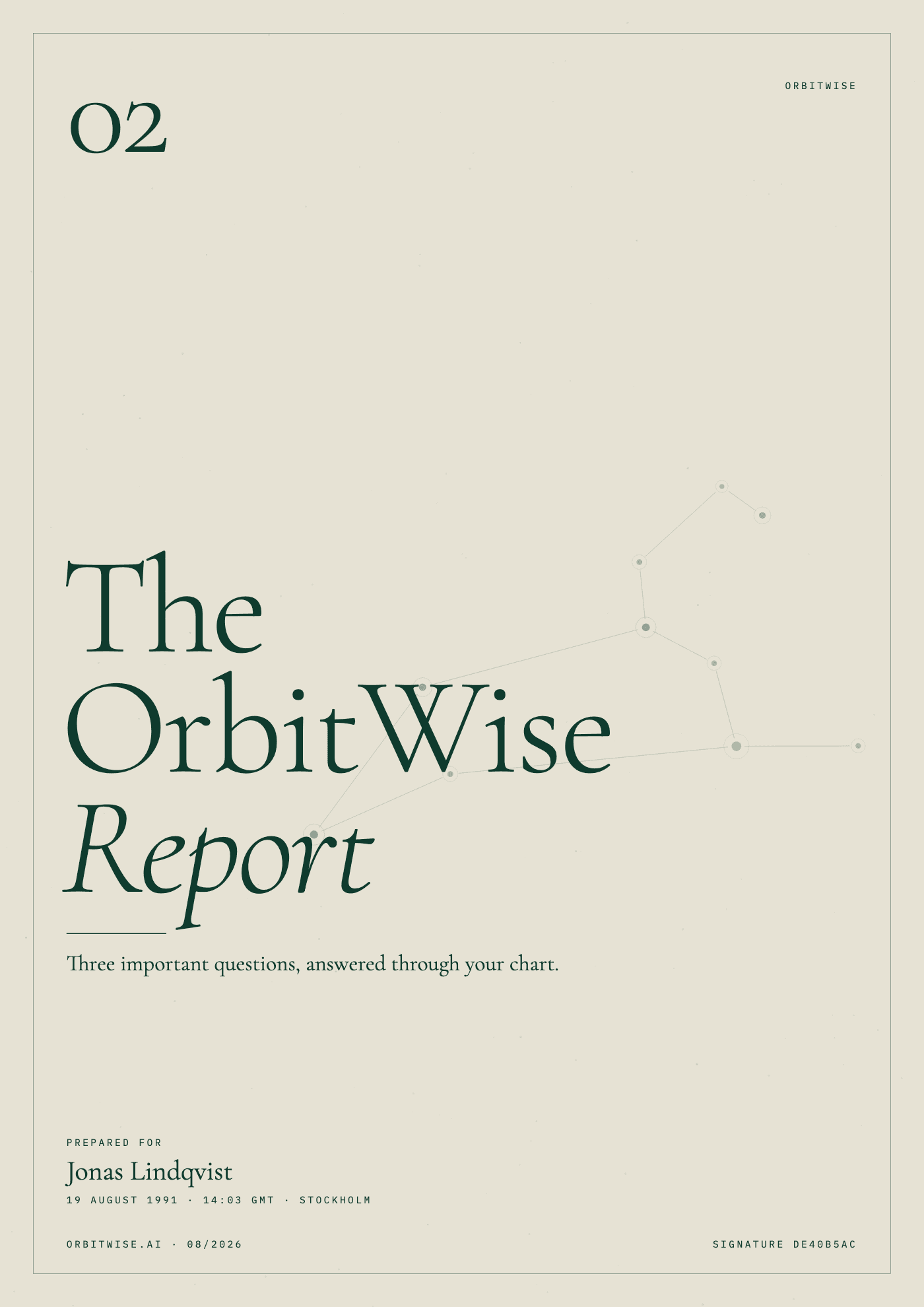
The artefact
The OrbitWise Report
- Three questions chosen by you
- Personal answers grounded in your chart
Bring the question: “Is this disruption a door or a detour?”
No account needed to buy · delivered within 48 hours.