The Annual Year-Ahead Forecast
“What is this year actually for?”
The Definitive maps your next twelve months quarter by quarter on top of a whole-life foundation: the transitions, the pressure points, and the windows worth building around.
You can list what you did last year. You cannot say what it was for.
The list gets written in the first week of January and quietly rewritten in March. By June most of it has been replaced by whatever actually turned up, and by November you are planning the next twelve months off the same blank page, by the same method, with no honest account of what the last twelve were. You did a great deal. You could not say what it added up to.
The same effort goes into the months that return it and the months that do not. So the biggest thing you attempt lands in a stretch that was never built for it, while the stretch that would have taken it somewhere goes on admin and small repairs. Twelve months on it reads as bad luck, or as thin discipline. It was neither. The year had a shape all along. The plan was written as though it did not.
Annual planning divides the work evenly. A year is not evenly built.
Every annual planning method starts by quartering the ambition and reviewing it monthly against the split. Quartering is a reasonable way to make a year workable, and it is also the whole of what the method knows about the year. Nothing in it reads the twelve months themselves, so the year is held still and the whole of the difference is put onto how hard you worked. A quarter that does not convert has one finding available to it, and that finding is always about the person.
The twelve months are not built alike. A year turns two or three times, and the stretches between those turns are built for different jobs: one for putting things up, one for closing things out, one that takes more than it returns whatever you put into it. Read against a specific twelve months, a chart names where the turns fall and what each stretch between them is set up to do. Not a forecast of events. A description of what the plan is being run through.
Most years are built for one job. Consolidating, expanding, repairing, releasing: one of those tends to be what the twelve months are actually for, and the rest of the year does the work that serves it. Split the ambition four ways and that one job competes with three other priorities in every quarter it has to run through, which is how a year with a clear purpose gets spent evenly and finishes vague.
Four equal quarters guarantee the year's one real job gets three months of the twelve.
A year does not ask the same of every part of a life. This orders what the twelve months ahead will keep coming back to, so the plan can be built around the year as it is rather than around how January felt. Your report leads its summary on the priority you set out at intake, writes each quarter against those goals, and dates the turns between them.
The year arrives as its major transitions, a strip of the whole twelve months, and four quarterly deep dives running forward from the cast date rather than from January. Where the year turns is dated. What each quarter is built for is written out, so a move, an application, a launch or the trip you keep postponing can be placed against the stretch that favours it.
Drawn from your real chart in OrbitWise Definitive, delivered within 5 days.
Get the DefinitiveThe questions a year-end review is too late to ask.
The question arrives as what should I do this year, and a goal list answers it without touching one of these six.
Which month your year actually begins in
Not January. A year takes its character from its transitions, and yours may fall in March or in September. Until the first one arrives you are still finishing the previous year's job, which is why the first quarter of so many plans quietly fails: it was written for a year that had not started yet.
Whether this is a year for adding or for finishing
Some years reward starting things. Others reward closing out what was begun two and three years ago and taking on nothing new, and in January the two feel identical. Adding into a finishing year is how people arrive in December with more unfinished work than they started with, all of it justified, none of it done.
Which quarter you should be visible in
The same work, put out by the same person, is received differently in different stretches of a year. Visibility is not a constant resource. Ask which months favour going out with something and which favour being heads down, then place the launch, the application, the talk or the difficult conversation where the reception is rather than where the work happened to finish.
What the year will take whether or not you budget for it
Every twelve months has one area that will demand time regardless of the plan: a parent, your health, a property, a relationship running on deferral. Given a place in the year it costs a quarter. Left out of the plan it does not go away. It arrives in whichever stretch you had reserved for the largest thing you wanted to do.
The stretch where the work stops feeling like the right work
Most years contain one stretch where the thing you are building stops feeling like the right thing. Undated, that feeling reads as a finding about the work itself, which is why good work gets dropped in the month it feels worst. Read against what its quarter is for, it starts looking like the stretch it belongs to instead.
How much of this year was decided before it started
A year is not independent of the ones before it. Part of what the next twelve months get spent on was settled by decisions taken two and three years ago, and the year is where the consequence lands. Separating the work the year brings you from the work you bring to it changes what is reasonable to expect of it.
What the twelve months put on the page.
The year's major transitions
The report names the transitions across the twelve months ahead: where the year changes character, what closes at each turn, and what the next stretch is built for. This is the section that tells you which month your year actually starts in.
The quarterly strip
The whole twelve months drawn as one banded strip, so the shape of the year is legible before a single quarter is read in detail. The demanding stretches and the quiet ones sit beside each other on one page.
Four quarterly deep dives
One long read per quarter, running forward from the cast date rather than from January: what that quarter is built for, written against the goals you set out at intake. Four of them, covering the full year ahead.
The present the year starts from
Where you stand at this moment read at four layers, with a thirty-day outlook and the week ahead in detail. A year you cannot act on this week is a year you will not act on at all.
The chapter the year sits inside
A hundred-year view of your periods, a deep read of the major period you occupy now, and the whole arc sorted into three chapters. This is what makes the twelve months a year of something rather than twelve months on their own.
Weighted to what you said mattered
The executive summary leads on the priority you set out at intake, with the secondary ones behind it and a quick-wins page. The alignment part holds strategic architecture, health vigilance, the full gemstone prescription, a city scorecard, numerology, warnings and a closing letter.
Forty-one to forty-seven pages, delivered within five days of a completed intake. The executive summary and the quick wins give a usable read in fifteen minutes; the rest is built to be studied. Cast once: there is no annual re-cast by design, and owners who want each quarter read as it arrives are invited into the quarterly rhythm of the OrbitWise Report instead.
A year read in one document still has to be lived twelve months at a time.
The report answers the question in writing: what the twelve months ahead are for, where they turn, and what each quarter between the turns is built to do. Answering it also fixes a record. Your chart resolved once, the transitions dated, the four quarters written out, and what you said at the sitting about what this year is meant to produce.
The read is the record, and the record is what stays answerable afterwards. In August something arrives four months before the quarter you set aside for it. Ask whether to take it now or hold it, and what comes back is the stretch the move belongs in, measured against dates already set down. On whether the deal itself is sound it sends you to your accountant.
What your reading learns about you is kept. The next thing you read starts from everything the last one knew.
Aster runs on a monthly plan. The deeper readings include a run of free days with him, and the credits the plan gives you each month go toward your next Report. Subscriptions are not open right now. See what Aster costs.
Our position.
Free will and personal choices matter most. Nothing here decides what you begin in March or whether you have finished it by November. A year is made of the work actually done inside it, and this read does not do an hour of that.
This describes what the twelve months are built to carry, not what you will get out of them. It names where the year turns, which stretches favour putting something up and which are better spent closing things out, and it says nothing about what you will have achieved in any of them. Two people handed the same year will spend it in entirely different ways, and that difference is theirs.
And it is one instrument among several. Set the goals, and keep the people who make a year happen: the accountant who runs the financial year, the doctor for anything the health page raises, and whoever asks in month four whether the plan is still the plan. Each of those governs what gets done. None of them describes the year they are being run inside.
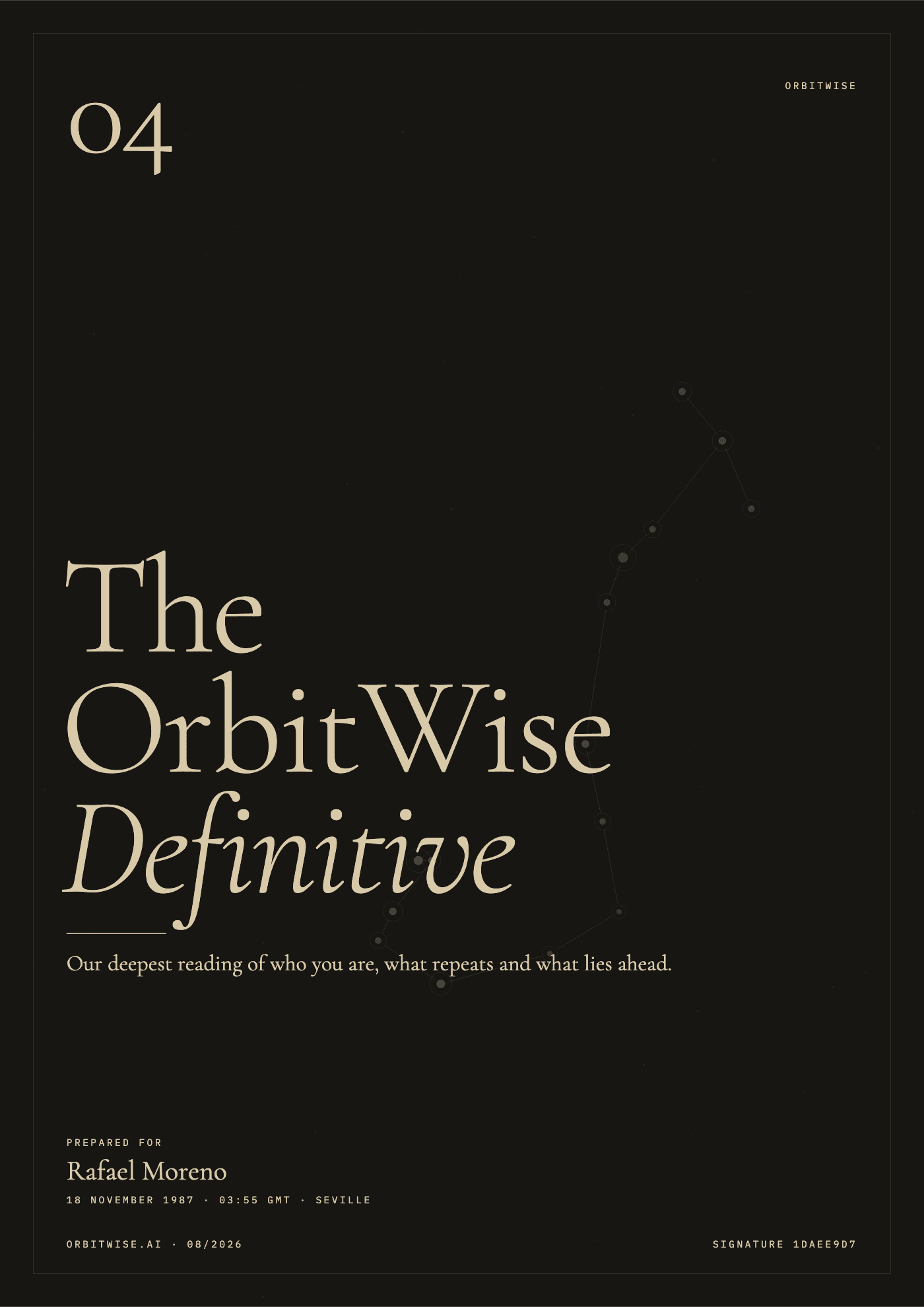
The artefact
OrbitWise Definitive
- Your major life periods
- The next twelve months in depth
Bring the question: “What is this year actually for?”
No account needed to buy · delivered within 5 days.