Finding Your Creative Inspiration Hubs
“Where does the work start flowing again?”
Output follows environment. The city read names the places that feed your specific creative mode, whether that is noise and collision or silence and distance.
You still have the skill. What you lost is the thing that starts the work.
You sit down at the same desk, at the same hour, with the same abilities you had three years ago, and nothing arrives. Not a block in the dramatic sense. Just a slow flattening: every idea you have is one you have had before, every draft is competent and dead, and finishing takes four times the effort it used to. You keep the discipline. The discipline is not the problem.
So you diagnose yourself. Burnout, age, the job, the phone. You buy the better notebook and set the earlier alarm. What almost nobody checks is the room, the street outside it, and the city that street is in, because environment sounds like an excuse and effort sounds like a virtue. Meanwhile the last time the work genuinely poured out of you, you were somewhere else, and you have never once treated that as data.
Discipline is advice about the tap. The problem is the well.
The universal advice for this is discipline. Show up daily, protect the hours, treat inspiration as an amateur's excuse. It is good advice and it solves exactly one problem: whether you are at the desk. It has nothing to say about what is there when you arrive. A habit is plumbing. It moves whatever is in the reservoir to where you need it, faster and more reliably than mood does, and it moves nothing at all when the reservoir is low.
What fills the reservoir is environmental, and it is not the same input for everyone. Some people are fed by collision: crowded streets, overheard arguments, thin walls, being slightly out of place. Others refill only in silence and distance, where nothing is asking anything of them. Put the second kind in the first kind of city and they will produce competent work for years and never once feel the thing arrive. Both call it a block. Both add another hour to the routine.
That intake preference is structural rather than a mood, and it is legible in a chart alongside the places that supply it. Read against actual coordinates it becomes a scorecard: which cities feed your particular creative mode, which ones flatten it, and what a place has to contain before the work starts coming. Not where artists go. Where your intake is met. Those are different addresses more often than not.
A routine moves what is in the well and has never once filled it.
The city scorecard reads the places you name at intake against the way your chart takes material in, and ranks them. Not where the art scene is. Which of your candidates supplies the conditions your work actually starts under, which one merely houses you comfortably, and what the city you are in now is costing the output.
A place is only half the answer, because the same city gives differently in different seasons. The plate draws the year ahead and names the stretches that favour going somewhere for the work, the ones that favour staying put and finishing what is already open, and the quarter where a change of base costs you least.
Drawn from your real chart in OrbitWise Definitive, delivered within 5 days.
Get the DefinitiveThe questions underneath a dry spell.
Everyone asks where to go. Almost nobody asks what the going is meant to supply. These are the questions that decide whether a change of place does anything at all.
Starvation or congestion
Two dry spells look identical from the desk and need opposite treatments. One is starvation: nothing new has entered you in a year, so the work recycles. The other is congestion: too much is coming in and none of it is being digested, so nothing settles long enough to become yours. A loud city cures the first and deepens the second. Work out which one you have before you buy the ticket.
Where you gather is not where you make
You may be asking one city to do two jobs. Gathering wants friction, strangers, being unsettled. Making wants boredom, the same walk every morning, nobody to perform for. Most people who feel permanently half-fed are hunting for one address that supplies both, when the honest answer is two places and a rhythm between them, one of which can be a train ride rather than a move.
The room the city gets blamed for
Before concluding the city is wrong, notice the scale of what actually changed the last time output returned. Often it was a different room, a window facing something, a walk that came before the work rather than after it. A city is an expensive way to fix a problem a hundred metres would have solved. The read separates the layer that is genuinely geographic from the layer that is furniture.
The place that fed you once
The city where the work once poured out of you is the first place everybody wants to go back to. It may have been the place, or it may have been being twenty-three there with nothing at stake. Your intake changes as your phase does, and somewhere that fed you under one set of conditions can be inert under another. Check what the city supplied, not what the years felt like.
Safe or slightly at risk
Some people only make things when something is slightly at risk: money, standing, a deadline with a person attached to it. Others produce nothing until they are entirely safe and unwatched. Neither is a virtue and both are stable across a life. Get it wrong and you spend years engineering the exact conditions that shut your work down, then calling the result laziness.
Who has to not be in the room
Environment includes people. There is usually one person whose presence in your week, or even in your notifications, quietly edits the work before it exists: a parent, a former teacher, an audience you acquired by accident. Distance from them is sometimes the entire content of a move, and it is the cheapest version of that move to test, because you can start by not telling them what you are making.
Where this question is answered in the document.
The city scorecard
The places you name at intake, scored against your chart and set beside the rest of the read, so where you work best is settled inside the same document rather than run as its own separate exercise.
The foundation, before any place
Part I reads the shape of you before it reads any place: the Shift, the Soul Blueprint, and a chart signature plate. What your creative intake actually is gets established here, and every place is scored against it.
The five mirrors
How you lead, decide, fight, love and hold money, taken one at a time. Where the work comes from runs straight through these, particularly what you do about money while a project is unfinished and how you take being told it is not working.
The twelve months, quarter by quarter
Major transitions named, a dated quarterly strip and four quarterly deep dives running forward from the cast date. This is where a move, a residency, a long stretch away, or the decision to stay put gets a date rather than an intention.
The present, in four layers
Part III reads the present in four layers, with a thirty-day outlook and the week ahead. It tells you whether the current flatness belongs to the phase you are in or the place you are in, which are different problems with different fixes.
The long river, and the three chapters
A hundred-year period view, a deep dive on the major period you are inside, and the three chapters of the life. Creative supply is not level across a life, and this is where you see which chapter you are making in and what it is for.
One cast from a long-form sitting: forty-one to forty-seven pages, within five days, twelve months of forward horizon. Strictly one-time, with no annual re-cast by design.
A place answers for a season, and then the work asks the question again.
The document answers where the work comes from and scores the places you brought to it. What the sitting also puts on the record is more durable than the scorecard: how your intake works, which conditions fill it, what your last productive stretch actually contained, and the chapter of the life you are making in. None of that expires when the year does.
From there it is an astrologer holding your creative supply rather than a filed document. Ask it in November whether the six weeks you have been offered in a quiet town will restart the work or merely remove you from it, and the answer comes back against the intake your read established. On the money side of taking unpaid time it does not advise, and names an accountant.
What your reading learns about you is kept. The next thing you read starts from everything the last one knew.
Aster runs on a monthly plan. The deeper readings include a run of free days with him, and the credits the plan gives you each month go toward your next Report. Subscriptions are not open right now. See what Aster costs.
Our position.
Free will and personal choices matter most. The work gets made by somebody sitting down and making it, in whatever room they have, and nothing here does a minute of that for you. A perfect city with nobody working in it produces nothing at all.
What this maps is supply and conditions. It cannot see whether the idea is any good, whether the person you live with will tolerate a year of it, or whether anyone wants the thing you are making. It has nothing to say about your ability. A city that feeds you is still a city where you can make bad work, and knowing the conditions does not excuse you from meeting them.
And it is one instrument among several. An editor tells you whether the work is landing. A teacher tells you what your technique is missing. A therapist tells you what you are avoiding by not making it. An accountant tells you how long you can afford to be away. Each answers a question about the work. This one answers where the work comes from.
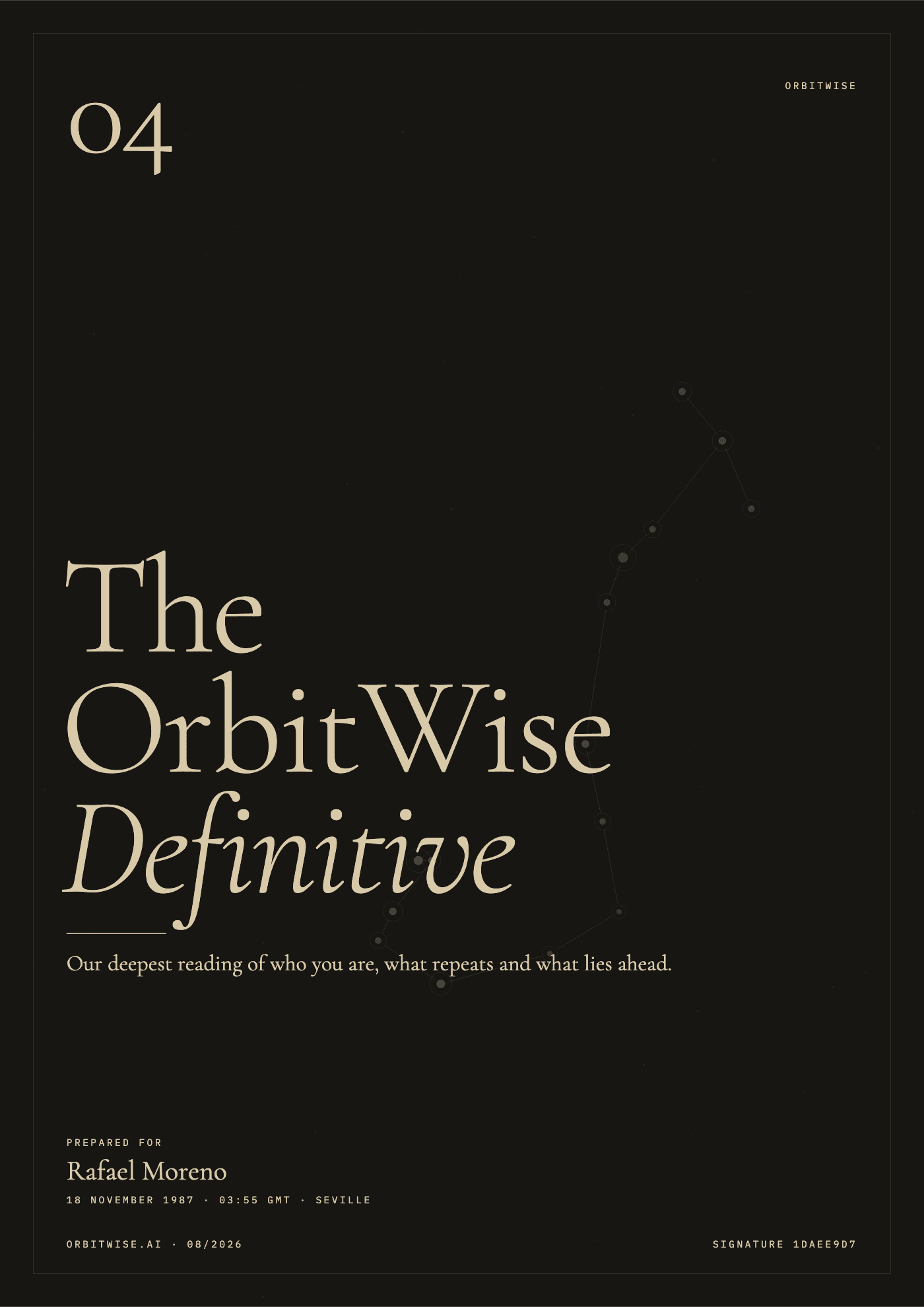
The artefact
OrbitWise Definitive
- Your major life periods
- The next twelve months in depth
Bring the question: “Where does the work start flowing again?”
No account needed to buy · delivered within 5 days.