Overcoming Subconscious Sabotage
“How do I keep getting in my own way?”
The pattern you consciously want to escape usually has your own fingerprints on it. The Definitive is built to show the mechanism: the fear underneath, and the practice that starves it.
You did not fail at it. You stopped a week before it would have worked.
There is a version of the last decade where three or four things went the whole way. The application you did not send. The relationship you ended in the good month. The work you kept private until somebody else published it. Each time you had a reason, and the reason held up at the time. What you cannot explain is why the reasons only ever arrive at the same point: close enough to want it, close enough that it could go wrong.
The cost is not the four things. It is that you have stopped putting yourself near the edge of anything, because you have watched what you do there and you would rather not watch it again. So the work stays a size you can finish. The people stay a distance you can hold. You are competent, you are busy, and there is a whole register of your life you have quietly agreed not to enter.
Everyone treats this as a discipline problem. It happens too fast to be one.
The standard advice splits two ways and both are decent. One says the problem is wanting: get clearer on the goal, raise the stakes, tell someone, build the habit, hold yourself to it. The other says the problem is history: something taught you that being seen is unsafe, and until that is examined you will keep pulling back. Both are aimed at a person deciding something. Both assume there was a moment where you weighed it up and chose wrong.
There was no moment. The move you make against yourself is a flinch, and a flinch is finished before the deciding part of you arrives. You do not choose to reread the email one more time until the day has gone. You do not choose to make the joke that takes the weight out of the room. By the time you have language for what happened, the thing is already three days behind you and you are building the reason. Willpower turns up late to a room where the furniture has been moved.
A chart read across a whole life works at the layer underneath the flinch. It names what the reflex is guarding, the conditions that switch it on, and the particular error you repeat when pressure arrives from that direction. That is a different object from a habit. A habit is something you do. This is something you are built to do faster than you can watch it, and it starves only when a practice is set against it, never when you want the opposite more.
A flinch is finished before the part of you that decides has arrived.
The move against yourself is never a single move. The five mirrors read your conduct in leadership, decision-making, conflict, romance and money, and the warnings page names the errors your chart runs towards. The ordering comes off your own placements, not off a category of person.
The pressure that triggers you is not spread evenly across a year. The twelve months ahead arrive as major transitions, a quarterly strip and four quarterly deep dives, naming the stretches that favour putting your name to something exposed and the ones that favour holding the practice and staying small on purpose. Each is dated.
Drawn from your real chart in OrbitWise Definitive, delivered within 5 days.
Get the DefinitiveThe questions that arrive after the fourth time.
The flinch is not available for inspection while it is running, and by the time it is over you have already written the reason. None of these six is a question about motivation.
The two seconds you have no memory of
Ask someone who has stopped themselves out of something what the moment felt like and they describe the aftermath, not the moment. There is a gap where the decision should be. That gap is the whole subject. Everything you can remember about it is reconstruction, assembled afterwards to make a person who chose look sensible, which is why arguing with the reason never changes the behaviour.
Why it fires hardest at the good news
The assumption is that sabotage arrives in a bad patch. It usually arrives in a good one. The offer lands, the second date goes well, the work gets noticed, and within two weeks you have found a reason to make it smaller. Difficulty is not the trigger. Proximity is. Anything that gets close enough to be lost is close enough to set the move off.
What the reflex is actually protecting
It is not protecting you from failure. Failure you have survived repeatedly and can describe in detail. It is protecting you from a specific exposure that has a shape: being seen wanting something, being the one who cared more, being found ordinary at the thing you are supposed to be good at. Until you know which one, every practice you build is aimed at the wrong door.
The version of you that shows up in a fight
The move against yourself is rarely the same in a meeting and in a kitchen. Some people concede at work and escalate at home. Others hold every professional line and cannot say a plain sentence to a partner about what they want. You have been treating this as one problem with one fix. It is one reflex with several costumes, and the costume decides which practice works.
Whether the pattern is yours or the decade's
Some stretches of a life pull the reflex forward and make it the governing fact of five years. Others leave it dormant and you look, from inside, like someone who has grown out of it. Telling those apart from inside the current month is not possible, and it matters, because one calls for building the practice now and the other calls for using a quiet stretch to do the work while nothing is pressing on it.
The practice that starves it, not the one that fights it
Most attempts to fix this are confrontational: catch the thought, argue it down, push through anyway. That gives the reflex something to work with, because it is faster than you. What actually costs it is structural and boring. A rule about when the thing gets sent. A person who is told before you can quietly not do it. A standing commitment that makes withdrawal expensive rather than free.
The pages that show you the mechanism.
Five mirrors, one reflex
The foundation carries five: leadership, decision-making, conflict, romantic and money. Each is a written account of how you conduct yourself in that arena, read against what you reported at intake. Read together they show the same move wearing different clothes.
The warnings, kept separate
In the alignment section: the errors your own chart inclines to, named plainly and held apart from the guidance so they cannot be softened by it. Alongside them, the strategic architecture, whose longest section goes to the priority you name at intake.
Where the pattern sits in a life
A hundred-year period view, a deep dive on the major period you are in, and your life sorted into three chapters. This is the layer that shows whether the reflex has governed one decade or all of them.
Twelve months, quarter by quarter
The year's major transitions, a dated quarterly strip and four quarterly deep dives. Sending it, saying it, or holding the practice through a stretch that will not reward exposure get placed against dated ranges rather than against how you feel that week.
A summary weighted to what you name
The front matter opens on the dominant priority from intake. If getting out of your own way is the governing question, it leads the executive summary, the secondary priorities follow, and a quick-wins page closes the front.
The near ground, and the close
The four layers of the present, a thirty-day outlook and the week ahead. Then health vigilance, the full Gemstone Crown, a city scorecard, numerology alignment and a closing letter written to be read more than once.
Cast once, from a long-form sitting that includes an optional health-context question. Forty-one to forty-seven pages, within five days, a twelve-month forward horizon on a whole-life foundation. It is not re-cast annually; owners move into the quarterly rhythm of the OrbitWise Report instead.
The document names the flinch once. You will meet it again in March.
The read answers the question in writing: what the move against yourself is, what it guards, and the practice that starves it. That answer stops being a conversation and becomes a record. Your chart resolved once. The sitting where you named the four things you stopped short of. The warnings, and the twelve months laid out next to them.
From then on it is an astrologer working from that record and everything you have raised since, so what you flinched from in March is still there in November. You are three days from sending something you have rewritten eleven times: ask whether the stretch favours putting it out, and what to do in the hour before you do. On the substance of a medical or legal call it does not advise, it names the right professional.
What your reading learns about you is kept. The next thing you read starts from everything the last one knew.
Aster runs on a monthly plan. The deeper readings include a run of free days with him, and the credits the plan gives you each month go toward your next Report. Subscriptions are not open right now. See what Aster costs.
Our position.
Free will and personal choices matter most. The email gets sent or it does not, by you, on an ordinary afternoon. Nothing here presses send, ends a relationship, or holds a line in a difficult conversation. Every time you have got out of your own way it was because you did something differently in a moment that belonged to you, and that will be true of the next time as well.
This is a map of the ground, not a verdict on the outcome. It sets out the reflex, the conditions that wake it and the stretches of the year that press on it hardest. It cannot see the conversation you had at nineteen that installed the flinch, or the text message that arrives on a Thursday and undoes three weeks of practice. Naming a pattern does not starve it.
And it is one instrument among several. A therapist is the right person for where the flinch came from and what it is made of, and this is not that. A coach can hold you to the practice week by week. A doctor should hear about it if the pattern comes with sleep, appetite or a mood that will not lift. None of them is set up to tell you which stretches of your year will test it hardest.
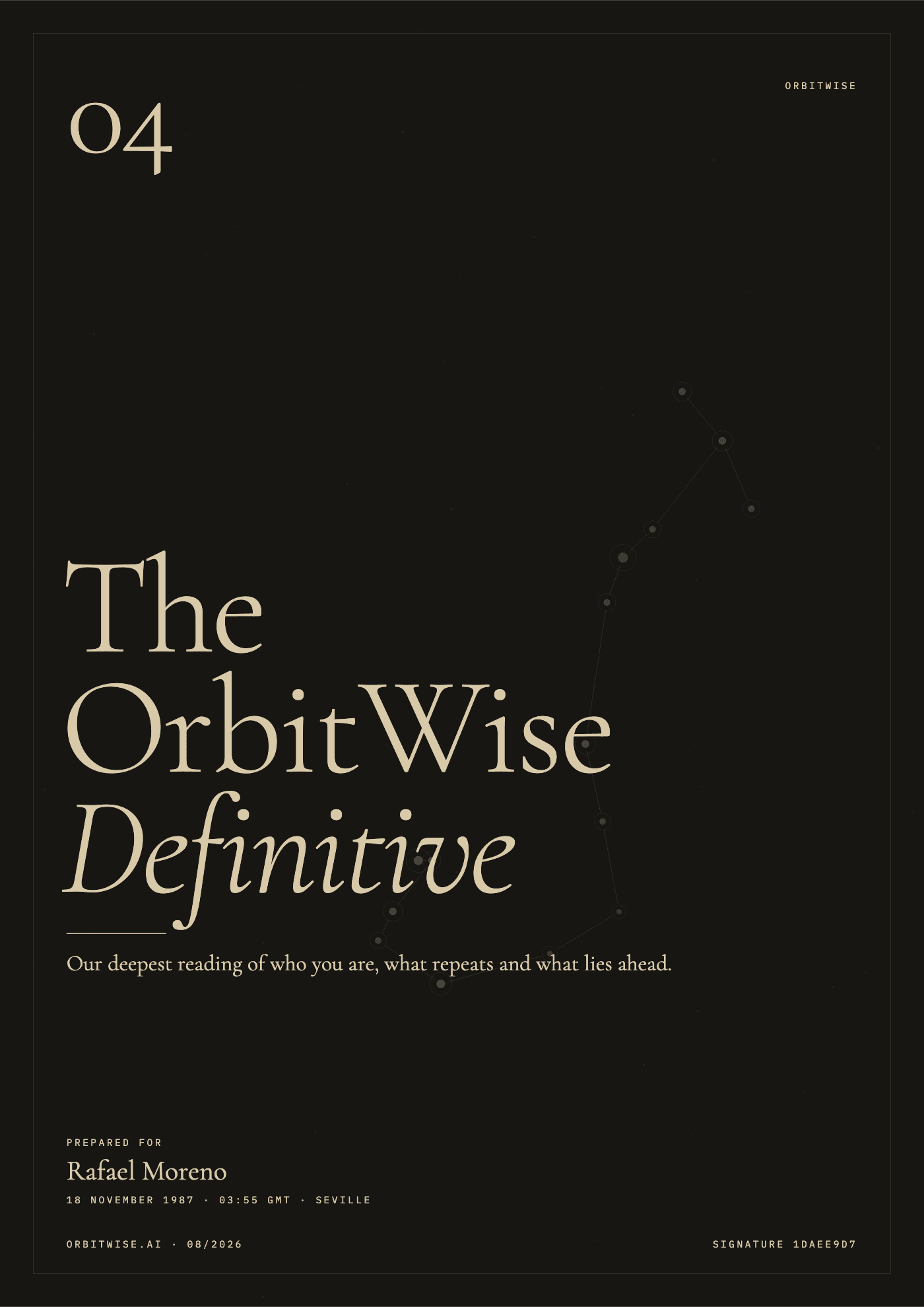
The artefact
OrbitWise Definitive
- Your major life periods
- The next twelve months in depth
Bring the question: “How do I keep getting in my own way?”
No account needed to buy · delivered within 5 days.