Mid-Life Transitions & Reawakenings
“What is ending on schedule, and what is beginning?”
The middle chapters ask different questions than the early ones. The Definitive reads what your midlife is dismantling on purpose, and what it is clearing space for.
Nothing is wrong, and you have quietly stopped wanting most of it.
The job is fine. The house is fine. You have been doing roughly the same week for eleven years and you can do it half asleep, and lately you do. Somewhere in the last two years you stopped adding things to the life and started counting them: how many more of these meetings, how many more school runs, how many more summers. You read about people who left. You tell yourself that is idle curiosity. It has not been idle since about your last birthday.
The cost is not the restlessness. It is what a person does with a restlessness they cannot explain. With no account of it you either hold still for another eight years and call that maturity, or you clear the whole arrangement out in one season and call that honesty. Both throw away the parts still working alongside the parts already finished. And whoever lives with you learns about it at the end, in a single conversation, rather than during, in twenty.
Every account of the middle calls it a crisis. Crises do not run on a schedule.
The counsel splits two ways and both aim at how you feel. One says wait, this is a phase, it lifts, make nothing permanent while you are in it. The other says this is your one life, reinvent, second act, go back for the thing you shelved at twenty-six. Both treat the restlessness as the event. The restlessness is not the event. It is the notice, arriving late, that something in the arrangement has reached the end of its term.
Lives run in chapters and chapters have lengths. What ends in the middle mostly ends on time: the career built to prove a point has finished proving it, the household the marriage was assembled to build is built, the friendships that ran on shared proximity have run out of proximity. None of that is failure and none of it responds to trying harder. It is a hinge. The first half's questions get retired whether or not you have new ones ready to put in their place.
That is the layer a read works at. A whole-life view sorts your years into three chapters and names the joins, so you can see which one is closing and how long the close usually takes. The major period currently running gets a deep dive of its own. Then the twelve months ahead arrive dated, so setting down and taking up stop happening in the same month by accident. The turn gets executed rather than endured.
A hinge only feels like a crisis if you were trying to stand still on it.
The middle does not dismantle a life evenly. It takes one department down to the frame and leaves the rest standing, and the one it takes is rarely the one you complain about at dinner. The five mirrors, on leadership, decision-making, conflict, romance and money, describe who you become in each as the turn goes through. Written against your own placements, never against your age.
A turn is not one moment, and its two halves are not simultaneous. Some passages of the coming year favour setting something down and others favour picking something up, and running those in the wrong order is how a person ends a marriage in order to start a business. The plate draws twelve months: major transitions, a dated quarterly strip and four quarterly deep dives.
Drawn from your real chart in OrbitWise Definitive, delivered within 5 days.
Get the DefinitiveWhat a turn settles while you are still calling it a mood.
None of these appear in the crisis literature, and every one of them decides what the second half is actually made of. You answer them, or the years answer them on your behalf.
The ending that is on time, and the one that is a flinch
Two things are ending and only one of them is due. A chapter closes because its term is up, and that arrives as flatness rather than pain. The other ending is you getting out ahead of a conversation you do not want to have. From inside a bad month the two are indistinguishable. What separates them is whether the thing was still asking anything of you before you began leaving it.
The audience the first half was built for
Most first halves are performed for somebody: a parent, a school, a colleague you have not seen in a decade. Somewhere in the middle that audience empties out, and the work carries on being done to their standard regardless. What reads as lost ambition is often just the room going quiet. Nothing has happened to the ambition. It has been playing to seats that emptied years ago.
The second half asks a different question
The first half asks whether you can. Can you get the job, hold a household together, be taken seriously by people who were not obliged to listen. Those get answered, and then people keep answering them for another fifteen years because nobody announces the exam is over. The second half asks what it is for and who it is for. That question is not harder. It is unfamiliar, and it does not respond to effort.
The thing you shelved at twenty-six
It comes back in the middle and it comes back persuasively. The instrument, the degree, the country. Some of those are genuine unfinished business and some are nostalgia for a version of you with fewer obligations. The test is whether you want the practice or the identity. One of those asks an hour a day for years. The other asks for a purchase and a photograph.
Who else in the house is turning
You are not the only person in the middle. A partner within a few years of you is running their own version of it, usually in silence and on a different schedule. Two turns in one household get read as one problem with one person at fault. When one of you wants less and the other wants more in the same year, that collision is structural. It is not a verdict on the marriage.
What you are keeping out of loyalty
Some of what you carry is still in use and some is kept because setting it down would feel like a betrayal. The friendship maintained out of history. The city stayed in for a parent. The professional description that stopped fitting four years ago and still gets said out loud at dinner. None of it is failing, and that is precisely what keeps it from ever being examined.
The sections that name what is closing, and what follows it.
Your life in three chapters
A hundred-year period view, your years sorted into three chapters with the joins named, and a deep dive on the major period currently running. This is the layer that locates the hinge and shows how long its close usually takes.
The Shift and the Soul Blueprint
The foundation opens on the Shift and the Soul Blueprint, with a chart signature plate. It is the account of what you were built to do, read before anything about the current year, so the turn is measured against the whole life rather than the last two.
The five mirrors
Leadership, decision-making, conflict, romantic and money, read one at a time against what you reported at intake. These are the departments a turn goes through, and this is where who you become in each of them is set down.
Twelve months, quarter by quarter
The year's major transitions, a dated quarterly strip and four quarterly deep dives. Setting something down and taking something up get placed against specific passages instead of against whichever week you happened to feel decisive in.
The near ground
The four layers of the present, a thirty-day outlook and the week ahead. It answers what the turn is asking this month, which is usually smaller and more specific than what it is asking of the decade.
Alignment, warnings and the close
A strategic architecture whose longest section goes to the priority you name at intake, health vigilance, the full Gemstone Crown, a city scorecard, numerology alignment, a stated set of warnings, and a closing letter written to you.
Cast once from a long-form sitting: forty-one to forty-seven pages, delivered within five days. A whole-life foundation with a twelve-month forward horizon and no annual re-cast by design. Owners who want the year taken quarter by quarter are invited into the quarterly rhythm of the OrbitWise Report instead.
The turn gets named in one sitting and then takes several years to complete.
The read answers what is closing and what the next chapter asks of you: your years sorted into chapters with the joins named, and the twelve months ahead dated. Answering it lays down a record at the same time. Your chart, resolved once. The long-form sitting where you said out loud what you had stopped wanting. The mirrors, written while you were mid-turn.
Eighteen months on you are weighing the smaller role and the smaller salary, and you genuinely cannot tell whether that is the turn completing or you giving up. Put it to an astrologer already holding the sitting, the chapter joins, and what you have actually set down since. On what the pay cut does to the pension it does not advise, and names a financial planner.
What your reading learns about you is kept. The next thing you read starts from everything the last one knew.
Aster runs on a monthly plan. The deeper readings include a run of free days with him, and the credits the plan gives you each month go toward your next Report. Subscriptions are not open right now. See what Aster costs.
Our position.
Free will and personal choices matter most. Nobody is moved into the second half of their life by a chart. You hand in the notice or you do not. You say the thing at the kitchen table or you carry it another year. Every ending in the middle is entered by a person doing something ordinary on an ordinary afternoon, and this document has no vote in any of it.
This is ground, not fate. It cannot see whether your employer restructures your department in March, what the person across the table has privately already decided, or what a scan would find. What it holds is which chapter is closing, which is opening, and where across the twelve months ahead the ending and the beginning each sit. Turning at the right time is still no guarantee you turn towards the right thing.
And it is one instrument among several. A therapist is the right person for what the restlessness is made of. A doctor is the right person for the tiredness, because at this age fatigue is a medical question before it is anything else. A financial planner tells you what a smaller salary costs across twenty years. A couples counsellor tells you whether the two of you are turning together.
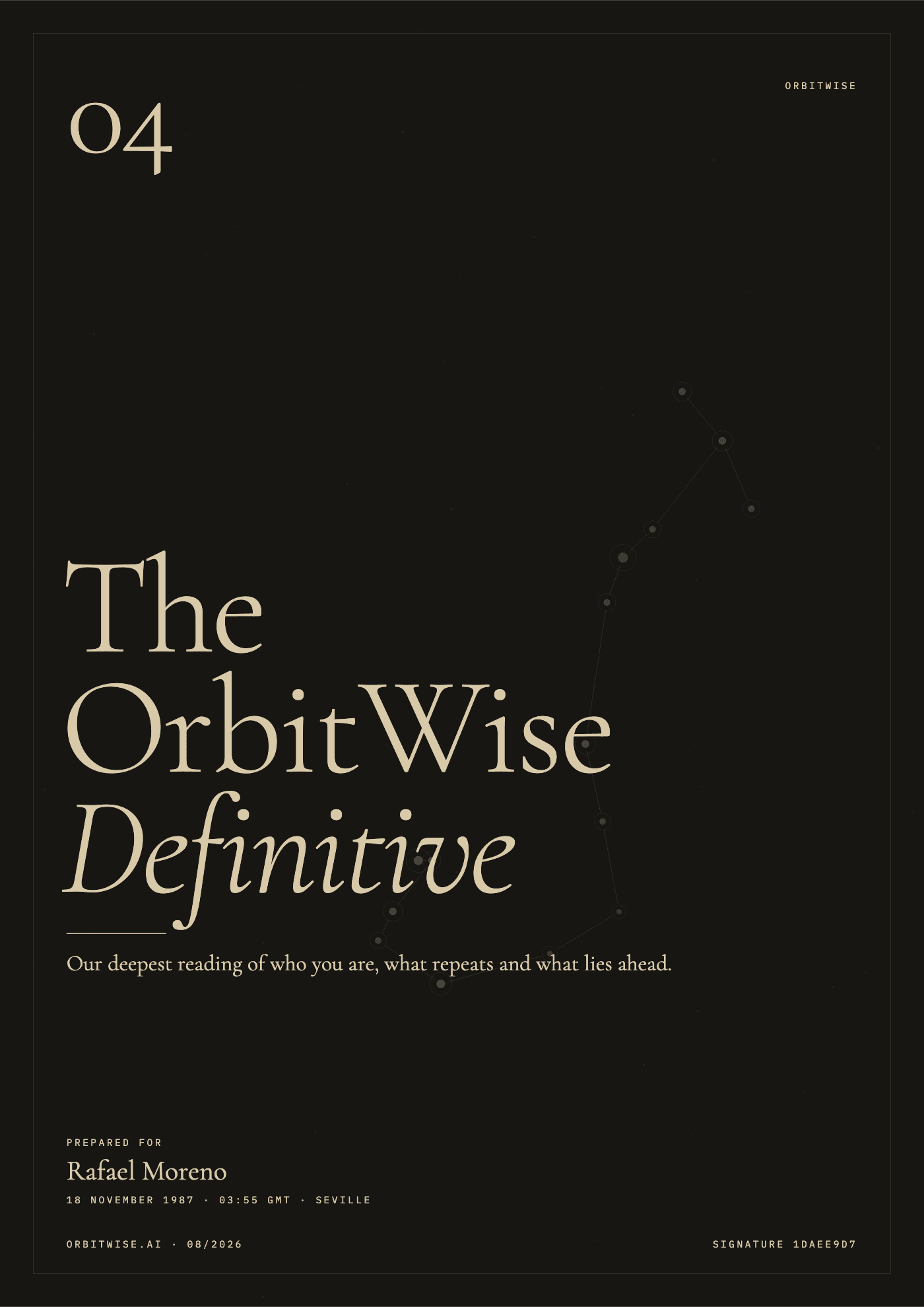
The artefact
OrbitWise Definitive
- Your major life periods
- The next twelve months in depth
Bring the question: “What is ending on schedule, and what is beginning?”
No account needed to buy · delivered within 5 days.