Creative Expression & Innovation
“How does my originality actually work?”
How you make new things is a chart signature: some build in public, some in silence, some only under deadline. The Definitive names your mode and the seasons that feed it.
Nobody has seen your best work because you have not decided it is finished.
It sits in a folder with a name only you would use. Four chapters and no fifth. A set of drawings you stopped scanning. Songs recorded to the point where the arrangement works and the vocal is still a guide take. You did not abandon any of it. You reach the stretch where the thing stops being possibility and becomes an object with faults, and at that point you open something new instead, and the new one is genuinely better.
The cost is not the unfinished work. It is what the pattern teaches you about yourself, one unshipped year at a time: that you are someone who starts. You take fewer things to the point of being judged, so less comes back, and less coming back means less to work from. People with a fraction of your range are three projects into a body of work while yours is still private. None of that is a shortage of ideas.
Finish what you start is advice for one kind of maker. You may not be that kind.
The counsel is settled and it is everywhere. Ship daily. Done beats perfect. Build the habit and the work follows. Show the process in public so an audience pulls the thing out of you. All of it treats an unfinished folder as a discipline failure, correctable by more consistency. That reading is wrong about most people who have one. You are not short of consistency. You have put years into the private version. What you are short of is the condition under which your particular mode closes something out.
Making has a mode, and the mode is structural. Some people need an audience watching to finish and starve in private. Some need silence and lose the thread the moment a draft is seen. Some only close things against an external deadline they did not set, and produce nothing in an open calendar. Those are not preferences you talk yourself out of. They are how your originality is wired, and a chart read names which one is yours instead of prescribing the one that worked for whoever wrote the book.
There is a second layer and it is seasonal. The stretch that generates is not the stretch that finishes, and they do not alternate on a convenient rhythm. Long periods favour accumulation, where the right move is to let things stay open. Others favour closing, and those are the ones people spend starting new work instead. A hundred-year period view and twelve dated months tell you which stretch you occupy, so the unfinished folder stops being evidence about your character.
An unfinished folder is rarely a failure of discipline and usually a mode nobody named for you.
Your chart signature is read for what actually drives your output, and the five conditions are ranked rather than listed. A high one is not a virtue and a low one is not a deficiency. What matters is that the top of your list is often the condition you have been trying to work without, on advice from somebody whose list is ordered differently.
The Definitive draws the twelve months ahead as major transitions, a dated quarterly strip and four quarterly deep dives. Read across a body of work, that strip separates the stretches that favour opening new things from the ones that favour closing what is already open. The dates are specific, and the quarters do not carry the same instruction.
Drawn from your real chart in OrbitWise Definitive, delivered within 5 days.
Get the DefinitiveThe questions that sit underneath an unfinished folder.
The question people ask is how to become more disciplined. Discipline is not the variable. These six are, and each one is answerable about you specifically.
Which half of the work is yours
Almost nobody is equally good at both ends. One kind of maker generates far more than they can process and needs someone or something to close things out. The other finishes everything they touch and struggles to begin. Both are functional, and both fail when run as though they were the other. Knowing which you are changes who you work with more than it changes how hard you try.
What being watched does to the work
For some people an audience is the engine: they finish because somebody is expecting it, and private work rots. For others the same attention is a solvent, and a piece shown too early never recovers. This is not shyness or confidence. It is a structural response, and building the wrong kind of public practice on it costs years of output.
The work you are keeping from yourself
There is usually one project you do not mention to anyone, including the people who would be encouraging. It is not unfinished for lack of time. It is the one where being wrong would cost something, so it stays unmeasured and therefore never fails. Its existence is data. What you protect that carefully is generally what your originality is organised around.
Whether your best years look unproductive
The stretches that build range often produce nothing visible: you read differently, take in other people's work, change your mind about what you are doing. Judged on output they look wasted, and the usual response is to force production and get thin work. Some periods are for intake. The error is not the quiet stretch, it is overriding it.
Who your work is arguing with
Most original work is a reply to something: a teacher, an industry standard, a house style you were trained in and cannot stand. The reply is usually invisible to the person making it. Naming what you push against explains why some projects carry heat and others, technically better, are inert. It also tells you when the argument is over and you are repeating yourself.
What you would make with no deadline at all
Some people answer instantly and some go blank, and that difference matters more than taste does. If an open calendar produces nothing, you are deadline-driven and should stop treating it as a weakness to correct. Build the constraint deliberately rather than waiting to be commissioned. If an open calendar is when the real work appears, protecting it is the job.
What the Definitive puts on the page about your making.
Your chart signature, plated
The full signature drawn as a plate, with the placements the read runs on set out rather than asserted. This is where the mode is named: what your output needs in order to close, and the conditions under which it stalls.
The five mirrors
Five reads of how you operate: leadership, decision-making, conflict, romantic and money. The decision-making and conflict mirrors are the ones that explain how collaborations end where they do, and who you can stand to be edited by.
The three chapters of the life
The hundred-year period view sorted into three bounded chapters with the joins named, plus a deep read of the major period you occupy now. A body of work reads differently once you know which chapter produced which part of it.
The twelve months, quarter by quarter
The year's major transitions, a dated quarterly strip and four quarterly deep dives running forward from the cast date. This is where the opening stretches and the closing ones get separated and given dates.
The present, at four layers
Where you stand now read at four layers, with a thirty-day outlook and the week ahead in detail. The short horizon is what you use when there is one specific thing you have been deciding whether to release.
The closing letter
The document ends in a contemplative register rather than on a task list, written to you, on what the arc adds up to. Warnings, health vigilance, the full gemstone section, a city scorecard and numerology alignment sit before it.
Cast once on a whole-life foundation with a twelve-month forward horizon, forty-one to forty-seven pages, delivered within five days. The executive summary is weighted to the priority you name at intake, so if the work is the priority, the work leads. There is no annual re-cast by design.
Your work carries on being made after the report stops being written.
The read answers how your originality works and what the year ahead is for. Answering it also sets down a record: your chart resolved once, the mode named, the three chapters with their joins, and what you said at the sitting about the projects that are open and the one you do not mention to anyone. The pages use that material. They do not exhaust it.
What sits underneath the document stays available, and questions can be put against it. Nine months on you have a finished piece and no idea whether to release it now or hold it to the spring. Put that, and it answers from the mode already named and the closing stretch the twelve months dated, not from how ready you feel this week. On the contract or the money it names the right professional.
What your reading learns about you is kept. The next thing you read starts from everything the last one knew.
Aster runs on a monthly plan. The deeper readings include a run of free days with him, and the credits the plan gives you each month go toward your next Report. Subscriptions are not open right now. See what Aster costs.
Our position.
Free will and personal choices matter most. Nothing gets made unless you sit down and make it, and nothing gets seen unless you decide to show it. The read does not write a line, close a project or send anything on your behalf. Every hour of the work is yours, and so is the decision to let anyone near it.
None of this predicts what you will make. It describes the ground you make on: the conditions your output runs on, which chapter of the arc this quarter is in, and where the year turns. It cannot see the work itself. It does not know whether the fourth chapter is any good, whether the mix is finished, or whether the drawings are worth scanning. Somebody with eyes on the actual pages tells you that.
And it is one instrument among several. An editor tells you whether the thing works. A teacher fixes the craft. An agent, a gallerist or a publisher knows what the market will take and when. A therapist is the right room for why you keep hiding it. Each works on the piece in front of them. None asks which stretch of your own arc you are trying to finish it in.
The artefact
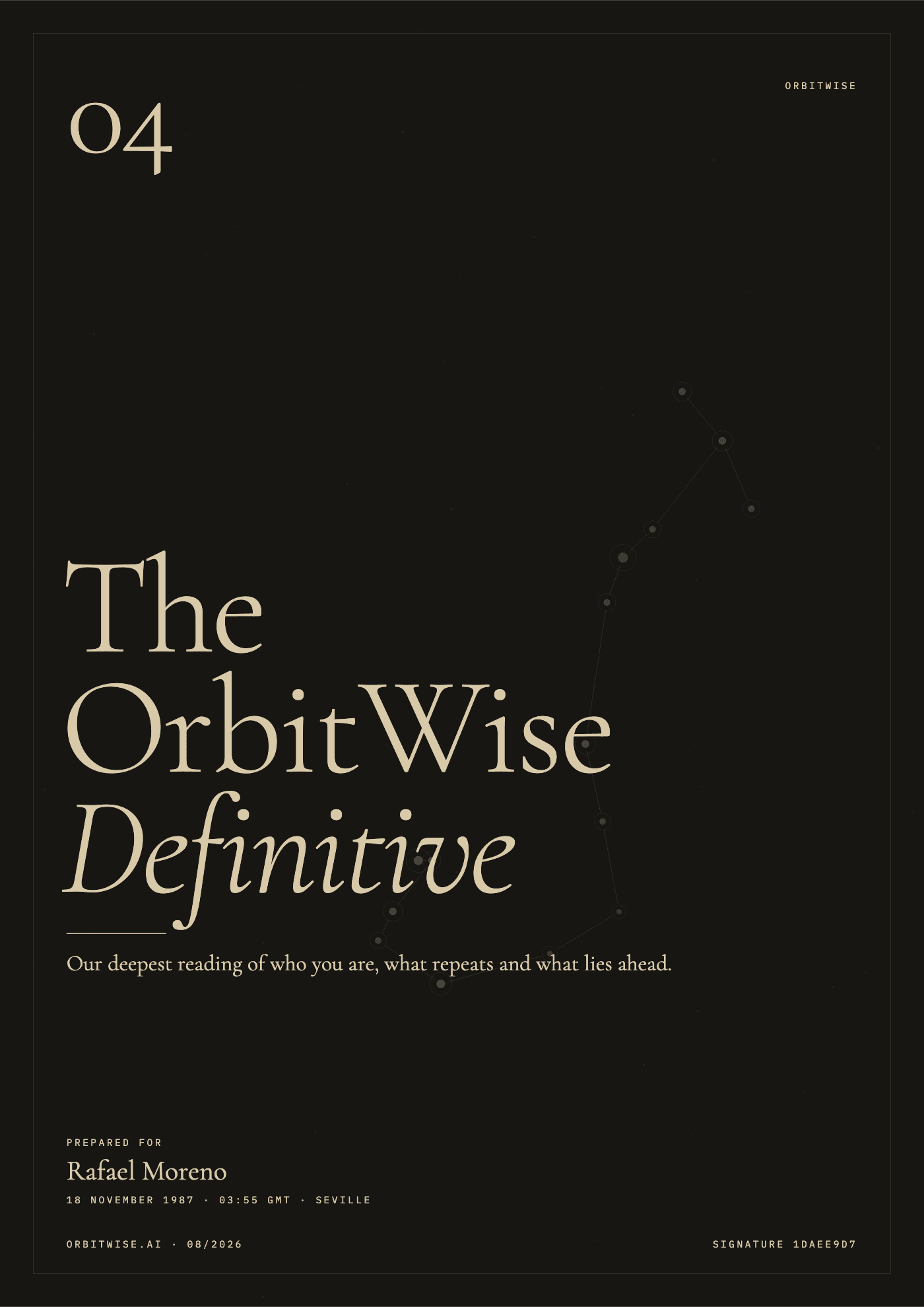
OrbitWise Definitive
- Your major life periods
- The next twelve months in depth
Bring the question: “How does my originality actually work?”
No account needed to buy · delivered within 5 days.