Aligning Daily Habits with Life Purpose
“What does my purpose look like on a Tuesday?”
Purpose fails at the level of the calendar. The OrbitWise Report turns the big direction into ninety days of dated dos and avoids, so the week finally matches the mission.
You know what you want your life to be about. Your week does not.
You have already done the difficult part. You know roughly what you want your life to be about, the kind of work that would justify the years, the person you intend to be at home. You wrote it down once and meant every word of it. Then the week arrives: messages, cover for someone who is away, three errands, an evening you gave away without being asked twice. By Friday you cannot name one hour that went to the thing you said mattered most.
Nothing broke, and that is why the month repeats. It does not register as a failure because nothing was dropped and nobody complained. It registers a year later, when the same sentence is still true and still not started, and you have quietly stopped believing your own statements about what you are for. The lost hours are the cheap half. The expensive half is becoming a person who says things rather than one who does them.
Habit advice can make anything stick. It has no opinion on what deserves to.
Start small. Stack the new behaviour onto one you already run. Track the streak and never miss twice. It works, and that is what makes it hard to argue with. What it delivers is repetition, and repetition is a mechanism with no preference: the same method installs a morning walk, a language app and the habit of reaching for your phone before you are properly awake. It tells you how to make a behaviour survive. It says nothing about which behaviour is worth ninety days of your life.
So the gap is not discipline. Most people who abandon a routine were running the right practice at the wrong intensity, or the right intensity in a stretch that was never going to hold it. Purpose gets decided once, in a good hour, at the level of a sentence. It then has to be spent in fifteen-minute pieces across ninety days that are not identical, by a person whose capacity moves week to week. The sentence never gets translated into dated behaviour, so it stays a sentence, and the week fills with whatever asks loudest.
A chart read against one named quarter does the translation. It says what these ninety days are for in your life rather than in general, which daily behaviours the stretch will repay, and which days will hold the version of a practice that asks something of you. The uncomfortable part is that the habit you defend hardest is often the one this quarter is least suited to, and keeping it at full size costs you the one it would have carried easily.
Purpose is decided in a sentence and spent in fifteen-minute pieces, and nobody dates the pieces.
A quarter does not refuse a habit outright. It repays some kinds of daily behaviour and quietly bleeds others, so an honest routine can run for six weeks and return nothing. The read ranks what these ninety days will repeat for you, strongest first, and names what the top one asks in return. It comes out of your own birth data, set against the exact quarter in front of you.
Ninety days ranked into peak, strong and steady bands, every day judged inside your own quarter rather than on a fixed external scale, with three protected windows dated to the day and a paragraph each. This is the page a routine gets written on: which stretch will hold the demanding version of a practice, and which stretch wants only the version you can keep on a poor morning.
Drawn from your real chart in The OrbitWise Report, delivered within 48 hours.
Ask my three questionsWhat nobody asks when the routine is the thing being fixed.
The question people bring is how to be more consistent. Consistency is a mechanism, and it is rarely the part that has broken. These six do more work.
Which habit is the actual purpose
A routine is usually one behaviour doing the work and four kept out of loyalty to an older version of the plan. The four are not harmless. They hold the hours the one needs, and they get defended precisely because they are easy. The read names which of your daily behaviours these ninety days will repay, and which are taking the morning without returning anything to it.
The version a bad week can hold
Every practice needs two settings: the full one, and the one that survives illness, a heavy stretch at work, or a month when your evenings belong to somebody else. Most people run only the full version, miss it twice and abandon the design. Knowing in advance which weeks will carry only the smaller version turns a break in the chain into something you planned for.
What you stop doing in order to start
A daily behaviour is never added to a life. It is paid for out of one. Thirty minutes comes from sleep, from your partner, from the hour you used to be reachable in. Most plans never name the source, so the payment is taken from whatever complains least, usually the people at home. A read that is direct about what the quarter can afford makes that a decision rather than an accident.
Whether purpose is meant to look like a project
Some people are built to express what they are for inside ordinary duties: how they run a shift, raise a child, hold a difficult room. Others need a separate body of work or the years feel spent. Confusing the two produces a familiar misery, one person guilty for having no project and another dutiful inside a job that will never be the thing. Settle it before building a routine on the wrong assumption.
The hour of the day that is genuinely yours
The morning routine is a genre rather than a finding. Some people get their two best hours before the house is awake and some are not usable until the light has gone. Which one you are is structural, not a discipline problem, and putting the work that matters most at the fashionable hour instead of your own is the reason it needs willpower at all.
What you do on the day after you break it
Everybody breaks a run of days. The variable is the morning after: restart quietly, abandon the whole design, or rewrite it into something harsher as a punishment. You will run that default whether or not you have ever looked at it. Named before the quarter starts, a broken week costs a week instead of the remaining ninety days.
Where the ninety days become behaviour.
What this quarter is for
Three paragraphs at the front: what these ninety days are built to produce in your life, the friction sitting inside them, and one date to mark. Written for a reader with no astrology behind them, and meant to be read before you touch the routine.
Ten dated moves
Five imperatives and five avoidances, each carrying its own date, on a single page. The avoidances are the half a self-improvement plan never contains, and they arrive dated rather than as principles.
The ninety days, banded
Your quarter ranked day by day into peak, strong and steady, judged inside your own ninety days rather than against a fixed scale. You see which stretch will hold the demanding version of a practice before you commit to doing it every morning.
Three windows to protect
Three dated windows, a paragraph each on what the window favours and what it is worth spending on. These are the weeks to keep clear of other people's requests, and the ones a new practice is best started inside.
Five questions, answered against the quarter
Career, deals, team, relationship and geography, three sentences each, answered for every reader. Relationship is the one that decides whether a daily practice survives contact with the people you actually live with.
One stone, with a protocol
A single stone named, how to wear it, and what the first sixty days with it involve. It is a daily instruction rather than an ornament, and it is the one part of the report that asks something of you every morning.
The OrbitWise Report is cast for one ninety-day quarter and regenerated in full each quarter, against fresh answers and an updated chart. It is never a re-skin of the previous edition.
A practice is not kept on the day you choose it. It is kept on the days after.
The report answers what these ninety days are for and dates the behaviour that follows from it. Getting there also writes down what an ordinary life keeps no record of: what you said mattered at intake, which practices the quarter was ranked able to hold, and the reason each window was chosen over the weeks around it. You spend the answer once. Nothing that produced it expires with the quarter.
That record is what an astrologer then works from, holding your chart, your quarter and everything you have raised with it since. Ask in week six whether to keep the evening practice through a stretch where the evenings belong to a parent who is unwell, or move it to the mornings until that passes. On the illness itself it has no view, says so, and names the doctor.
What your reading learns about you is kept. The next thing you read starts from everything the last one knew.
Aster runs on a monthly plan. The deeper readings include a run of free days with him, and the credits the plan gives you each month go toward your next Report. Subscriptions are not open right now. See what Aster costs.
Our position.
Free will and personal choices matter most. Every repetition is yours. Nobody else gets up, sits down, or keeps going in week seven when the thing has stopped being interesting, and nothing here takes a single morning of that off you. A well ranked quarter spent doing nothing produces nothing.
What arrives is ground rather than a verdict: the shape of the ninety days you are about to repeat something into, and which stretches will hold the demanding version. What it cannot see is your household. A newborn, a parent who needs collecting at six, a partner who has just moved to nights: none of that sits in your birth data, and any one of them decides which hour is available at all.
And it is one instrument among several. Keep whatever system already works for you. Take a coach's read on whether the goal is the right goal, a therapist's on why the same practice keeps being abandoned in week three, and a doctor's if the tiredness is constant however the days were ranked. The quarter answers something narrower than any of them: which of the next ninety days a given piece of behaviour belongs in.
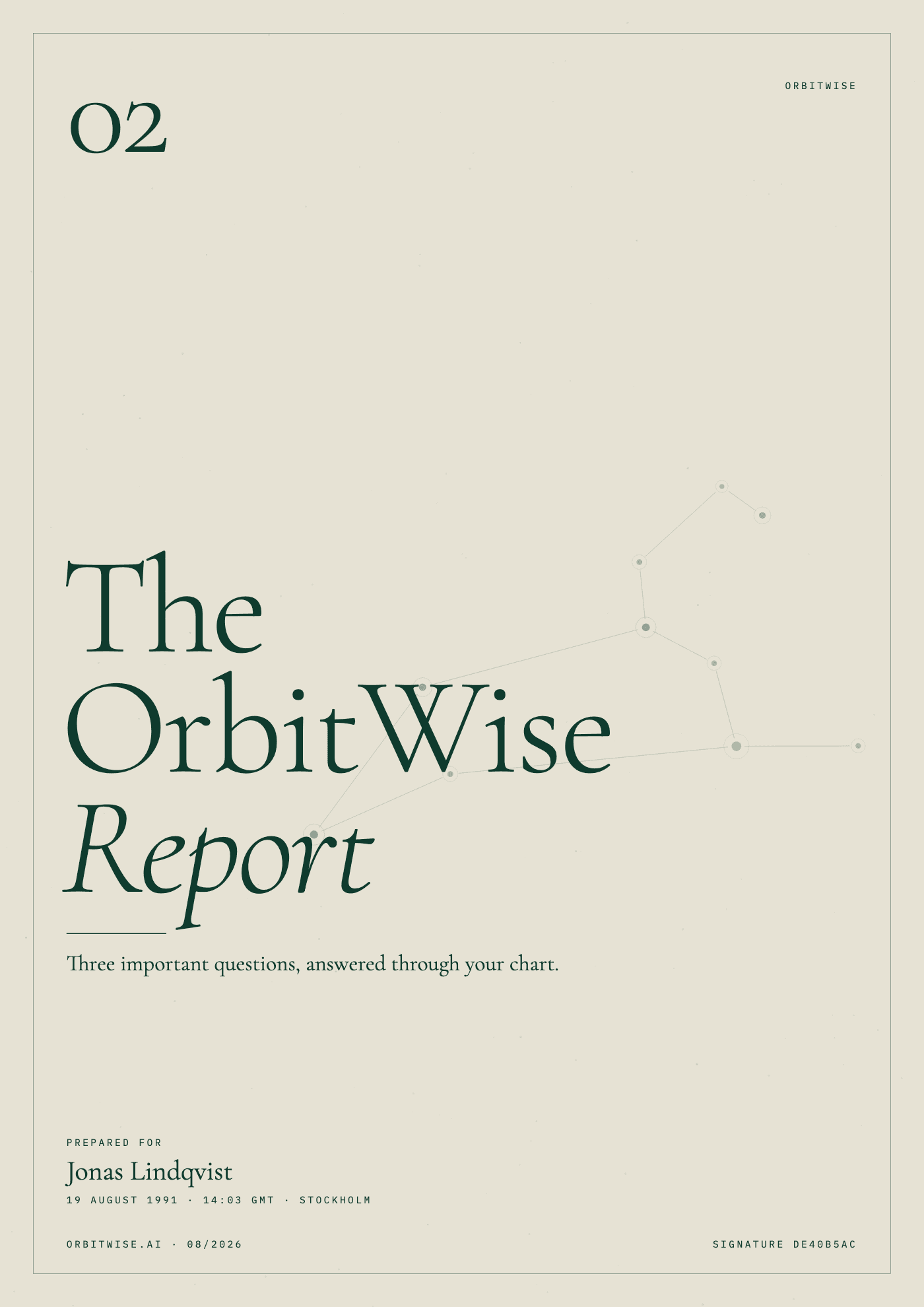
The artefact
The OrbitWise Report
- Three questions chosen by you
- Personal answers grounded in your chart
Bring the question: “What does my purpose look like on a Tuesday?”
No account needed to buy · delivered within 48 hours.